

What if the first step towards an MRI isn’t booking a scan, but having the right clinical conversation? A fast MRI referral in Wigan should begin with an assessment of your symptoms, because MRI may not be the most suitable investigation for every concern.
It’s understandable to want clear next steps when you’re worried about symptoms or facing delays. At Ready Health in Standish, you can discuss your concerns with a clinician, who can consider whether an MRI referral is appropriate and explain how a scan can be arranged through private hospital and diagnostic-centre partners. This guide covers what to expect, how to prepare and how the scan pathway works. A consultation does not guarantee a referral or a particular appointment time.
Key Takeaways
- A fast MRI referral Wigan pathway starts with a clinician discussing your symptoms and whether MRI may be suitable for you.
- Prepare appointment details, a clear timeline of your symptoms and relevant medical history to make your discussion more useful.
- Tell the clinical team about any implants, metalwork or other medical information that could be relevant to a scan.
- MRI, CT and ultrasound use different imaging methods, so the right option depends on your symptoms, history and the information needed.
- If MRI is appropriate, Ready Health arranges scans through partner hospitals and diagnostic centres, and explains the next steps in your pathway.
Fast MRI referral in Wigan: what the route involves
Uncertainty about symptoms can be difficult, especially when you’re waiting for answers. MRI, or magnetic resonance imaging, uses magnets and radio waves to create images of structures inside your body. A fast MRI referral Wigan pathway is about progressing an appropriate assessment and scan arrangements, not promising immediate imaging. At Ready Health in Standish, the first step is a discussion with a clinician about your concern.
Some private imaging providers offer self-referral for certain scans. Ready Health takes a clinician-led approach: you discuss your symptoms first, then the clinician considers whether MRI may be suitable. This helps connect the scan to a clear clinical question, rather than treating imaging as the automatic next step for every symptom.
What an MRI scan can show
MRI can create detailed images of joints and soft tissues, as well as some organs and structures relevant to neurological concerns. Unlike X-rays and CT scans, MRI does not use ionising radiation. For a general overview of how it works and where it is used, see Magnetic Resonance Imaging (MRI).
The useful question isn’t simply whether an MRI can produce an image. It’s whether that image could help address your particular concern. The area examined and type of imaging considered depend on your symptoms, medical history and the information a clinician needs.
When a referral conversation may be helpful
A clinician discussion may help when you have a persistent or concerning symptom and want to understand whether imaging could answer a specific question. You can describe when the symptom began, how it has changed and how it affects you. The clinician can consider this information alongside your relevant medical history.
An MRI isn’t necessary for every unexplained symptom. Depending on your circumstances, another investigation or a different next step may be more appropriate. A referral conversation gives you space to understand the reasoning and options, rather than assuming that a scan is required.
A clinician-led MRI referral is an assessment of whether MRI may be appropriate for your symptoms, followed by a discussion of scan arrangements if it is considered suitable.
If MRI is appropriate, Ready Health arranges scans through private hospitals and diagnostic centres. Your clinician can explain the next steps and how the pathway applies to you. A fast route means moving the assessment and arrangements forward, not guaranteeing a particular appointment or result timeframe.
How to discuss and arrange an MRI through Ready Health
A clear process helps you understand what happens after you raise a concern. At Ready Health, arranging an MRI starts with a clinician appointment, so your symptoms and the purpose of any scan can be considered before arrangements are discussed.
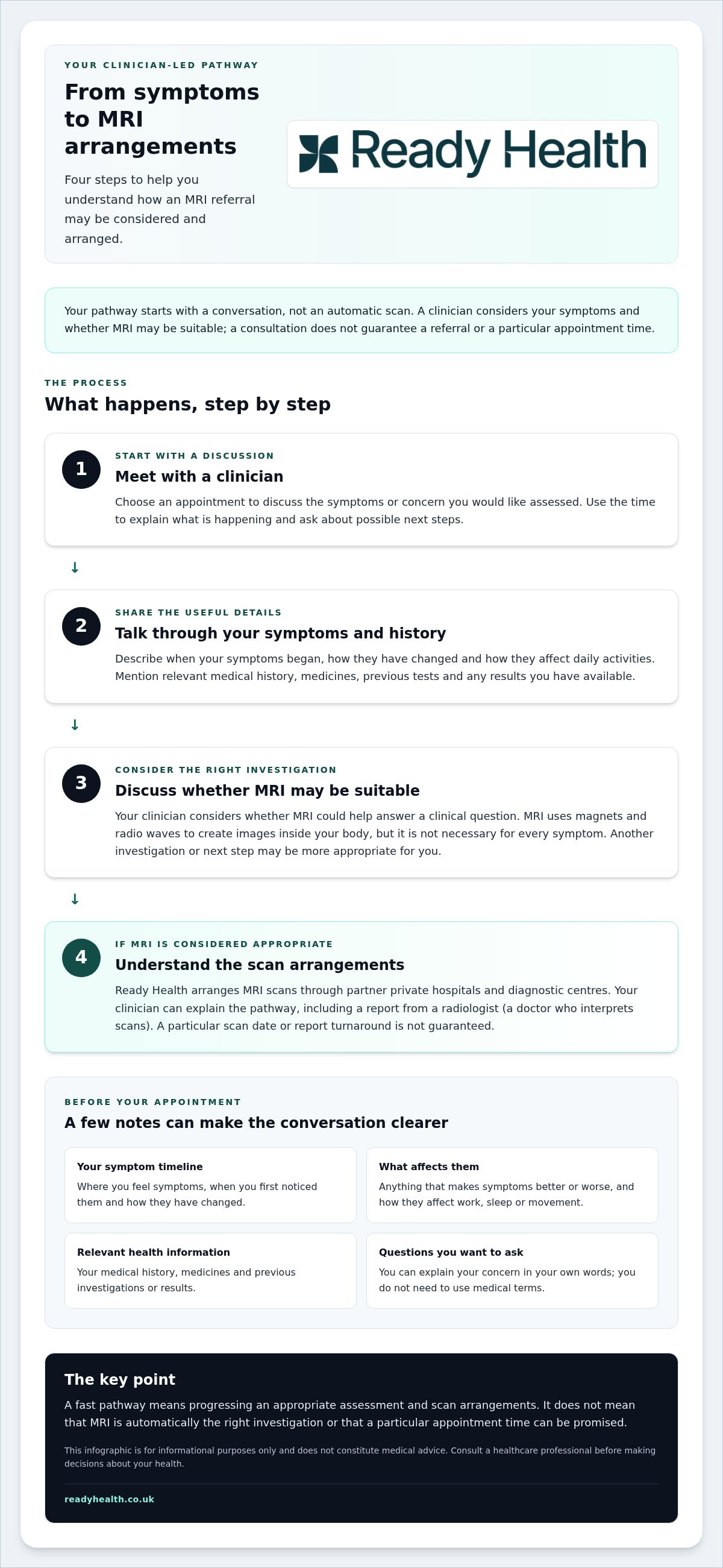
- Book a clinician appointment. Choose an appointment to discuss the symptoms or concern you’d like assessed. This gives you time to explain what’s happening and ask questions about possible next steps.
- Talk through your concern. Describe when your symptoms began, how they’ve changed and how they affect daily activities. Mention relevant medical history, medicines and any previous tests or investigations.
- Consider whether MRI may be suitable. The clinician uses the information you share to consider whether MRI could help answer a clinical question. A scan isn’t automatic; another investigation or next step may be more appropriate for your situation.
- Discuss arrangements if MRI is considered appropriate. Ready Health arranges MRI scans through partner private hospitals and diagnostic centres. Your clinician can explain the pathway and arrangements, without promising a particular scan date or report turnaround.
What to explain during your clinician appointment
It may help to make a few notes beforehand. Include where you experience symptoms, when you first noticed them, whether anything makes them better or worse, and how they affect work, sleep or movement. You don’t need to use medical terms. A straightforward account in your own words is useful.
Also mention relevant medical history and previous investigations, including any results you have available. This context helps the clinician understand what has already been considered and what question, if any, imaging might address.
What may happen after the assessment
The assessment may lead to a discussion about MRI, a different investigation or another appropriate next step. If MRI is considered suitable, Ready Health arranges the scan through its private hospital and diagnostic-centre partners. The imaging pathway includes a report from a radiologist, but individual timing isn’t guaranteed.
Preparing your notes can make the conversation more focused, but you don’t need to decide in advance that you need a scan. The clinician’s role is to consider your concern and explain the reasoning behind the suggested pathway. That way, a fast MRI referral Wigan route is based on assessment, not simply speed.
If you’re ready to discuss your symptoms, you can book a clinician appointment with Ready Health and take the next step in the conversation.
MRI, CT, or ultrasound: how clinicians consider imaging options
Different scans use different methods and can answer different clinical questions. MRI, CT and ultrasound aren’t interchangeable, and choosing the most detailed-sounding option doesn’t necessarily make it the right one. A clinician considers your symptoms, relevant history and the information needed before discussing which investigation may be appropriate.
Imaging
How it works
Questions it may help investigate
MRI
Uses magnets and radio waves to create detailed images inside the body.
May help examine joints, soft tissues, organs or some neurological concerns.
CT
Uses X-rays taken from different angles to build cross-sectional images.
May be considered when a clinician needs images of internal structures from multiple angles.
Ultrasound
Uses sound waves to create images of structures inside the body.
May help assess particular organs or soft tissues, depending on the concern.
X-ray
Uses a small amount of ionising radiation to create an image.
May help examine certain structures, such as bones, when clinically appropriate.
How MRI differs from CT and X-ray
MRI uses magnetic fields and radio waves, rather than X-rays, to form images. CT and conventional X-rays use ionising radiation, but they produce images in different ways: CT builds cross-sectional views from multiple X-ray measurements, while an X-ray produces a simpler image. None is universally better or safer; the benefits and considerations depend on the person and the clinical question.
Why the right scan depends on your clinical question
The body area and what the clinician needs to understand can shape the imaging discussion. For example, a concern involving a joint or soft tissue may prompt different considerations from one involving an internal organ or possible bone injury. An ultrasound scan may be considered for some questions, while MRI or another investigation may suit others.
The right imaging choice is the one that may provide useful information for your symptoms and clinical history, not simply the scan you request first.
A scan also isn’t a substitute for clinical assessment. Your clinician considers your symptoms, relevant medical history and any previous investigations, then weighs whether imaging could help guide the next step. Sometimes another investigation, or no imaging at that point, may be more appropriate.
If you’re considering a fast MRI referral in Wigan, a clinician can discuss whether MRI fits the concern you want assessed. This keeps the conversation focused on what information may be useful for you, rather than assuming MRI is the answer for every symptom.
How to prepare for an MRI referral and scan near Wigan
A little preparation can help you explain your concerns clearly and make the most of your appointment. If you’re considering a fast MRI referral Wigan pathway, gather useful information in advance, but don’t assume that any single symptom or detail determines whether MRI is suitable.
Information to have ready before your appointment
Jot down what you’ve noticed and take any relevant appointment or investigation details with you. You don’t need a perfect medical history. Clear notes can help you describe what’s changed and what you’d like to understand.
- Your symptoms: Note where they occur, when they began, how often they happen and whether they’ve changed.
- The effect on daily life: Consider whether symptoms affect movement, sleep, work or other usual activities.
- Your medical history: Include relevant diagnoses, previous scans or investigations, and any results or letters you have available.
- Your medicines: Make a list of current medicines, including doses if you know them. Don’t stop or change medication unless a clinician advises you to.
- Your questions: Write down what you’d like to ask about the proposed next step, scan arrangements and how results will be shared.
This information gives the clinician context for understanding your concern and considering what may be appropriate. If you don’t know an exact date or medical term, say so. Your account in everyday language is still useful.
Safety information to share before MRI
MRI screening helps the imaging team understand relevant safety considerations before a scan. Tell the clinician and imaging team about any implants, metalwork, metal fragments or medical devices, even if you’re unsure whether they matter. Include details such as what the device is and, if known, when it was fitted.
Also disclose pregnancy or possible pregnancy to the clinical team. This doesn’t mean you should decide on your own whether a scan can go ahead. The imaging team can consider your individual circumstances and explain the appropriate arrangements.
Preparation instructions can vary depending on the scan and your circumstances. Follow the guidance provided by the imaging team rather than general online advice, and ask them if an instruction is unclear. Don’t assume you need to fast, remove a particular device or alter medication unless your clinical team tells you to.
Ready Health is based in Standish, Wigan, where you can discuss your concern with a clinician. MRI scans are arranged through partner hospitals and diagnostic centres, so the clinic appointment and scan location are separate parts of the pathway. Your scan arrangements and any preparation instructions will be explained as the process progresses.
To prepare for a clinician discussion, book an appointment with Ready Health and bring the notes and questions that feel relevant to you.
Book a clinician discussion for a fast MRI referral in Wigan
If you’re considering an MRI, the next step is to discuss your concern with a clinician. A fast MRI referral Wigan patients explore through Ready Health begins with an individual assessment, not an automatic scan booking. The clinician can consider whether MRI may be appropriate and explain the next steps for your situation.
Your next steps with Ready Health
Ready Health’s clinic is based in Standish, Wigan. Your appointment is the starting point for discussing your symptoms and whether an MRI may help answer a clinical question. If MRI is considered suitable, scans are arranged through private hospital and diagnostic-centre partners. The scan location is separate from the Standish clinic.
To make the conversation focused, bring any symptom notes, relevant medical history and details of previous investigations that you have. You can also share what you hope the scan might clarify. The clinician will consider this information and explain the agreed pathway. This may involve MRI, another investigation or a different next step, depending on the assessment.
An appointment does not guarantee an MRI referral or a particular scan or report timeframe. A clinician discussion helps ensure the proposed route is considered in light of your individual concern, rather than relying on a scan request alone.
Keep the wider care plan in view
If you have a scan, its findings are considered alongside your symptoms, medical history and clinical assessment. An image is one part of the picture; its meaning and relevance depend on the wider context. Your clinician can discuss what the findings may mean and whether any follow-up is appropriate.
Depending on the findings and your needs, onward specialist input may form part of the next step. The appropriate route will depend on your circumstances, and a referral or particular outcome can’t be assumed in advance. You can use your appointment to ask how the results will be communicated and what follow-up may be considered.
Taking a measured next step can make the process clearer. Book a clinician discussion, explain the concern you want assessed, and follow the pathway agreed with the clinician. This keeps the focus on suitable care, whether or not MRI is recommended.
If you’re ready to discuss your symptoms, book a clinician appointment with Ready Health in Standish, Wigan.
Take a clear next step for your health
It’s natural to want answers when a health concern is affecting your life. A fast MRI referral Wigan pathway can begin with a focused conversation, giving you space to explain what’s happening and understand the options before deciding what to do next. You don’t need to know which scan you need in advance; start by sharing your concern and let clinical assessment guide the discussion.
Ready Health is based in Standish and serves people across Wigan, Shevington, Standish Lower Ground, Boar's Head, Wrightington, Appley Bridge, Chorley, Skelmersdale, Orrell, Ashton-in-Makerfield, Bolton, Leigh, Preston, Southport and St Helens. Book a clinician appointment with Ready Health to discuss your symptoms and explore the next step.
Frequently Asked Questions
Can I get an MRI scan in Wigan without a referral?
Some private imaging centres accept self-referrals for selected scans, but Ready Health’s pathway begins with a clinician discussion. This gives you an opportunity to explain your concern and understand whether imaging may be a suitable next step. Consider what you want the scan to clarify and whether you have relevant medical information or previous results to share.
How do I arrange a fast MRI referral through Ready Health?
Book a clinician appointment with Ready Health and explain what you’d like assessed. You can bring previous scan reports or investigation results if you have them, which may help provide context. The clinician will discuss possible next steps with you. If MRI is considered appropriate, arrangements are made through private imaging partners.
Does a clinician appointment mean I will definitely have an MRI?
No. The purpose of the appointment is to assess your concern, not to guarantee an MRI. The clinician may feel another investigation or a different course of action is more relevant. You can ask what each option is intended to clarify and discuss any concerns you have before deciding how to proceed.
How quickly can I have a private MRI scan in Wigan?
There’s no single appointment timeframe that applies to everyone. Timing depends on your assessment and arrangements with the imaging partner. Ready Health arranges private MRI scans, but this isn’t a guarantee of an immediate scan or a specific date. If you have a time-sensitive concern, explain this during your appointment so it can inform the discussion.
What happens after my MRI scan and who reviews the images?
A radiologist reviews the images and prepares a report. The findings are considered alongside your symptoms and clinical history, so the report should be discussed in context. You can ask your clinician how the result will be shared, who will explain it to you and whether any follow-up may be appropriate.
Is an MRI scan suitable for everyone?
No. Whether MRI is suitable depends on the clinical question and your individual circumstances. Before a scan, tell the clinical team about implants, metalwork, medical devices, or pregnancy or possible pregnancy. The team can assess the relevant information and explain what it means for your scan. Don’t try to determine your suitability from one detail alone.
What should I tell the clinician before discussing an MRI?
Describe what you’ve noticed, when it started and how it affects your day. Mention relevant diagnoses, medicines, previous investigations and any results you can bring. It can also help to explain what you hope to understand, such as whether a symptom has a particular cause. You don’t need medical terminology; clear notes in your own words are useful.
Ready to discuss your concern? Book a clinician appointment with Ready Health and take the next step guided by your assessment.
Disclaimer: This content is for informational purposes only and does not constitute medical advice. Consult a qualified healthcare professional before making decisions about your health.

Article by
Shamir Patel
Shamir Patel is a UK-based Clinical Pharmacist and Independent Prescriber with a specialist focus on ADHD and weight management.
He is the Registered CQC Manager at Ready Health Medical Clinic, where he leads the development and delivery of safe, patient-centred services across ADHD assessment and treatment, weight loss programmes, and general medical care.
With a career spanning nearly three decades since qualifying in 1995, Shamir brings extensive clinical and operational experience across both community pharmacy and private healthcare.
He also serves as Deputy Superintendent Pharmacist and Lead Prescriber at PillSorted. He oversees high-volume prescribing services. He focuses on GLP-1 weight loss treatments and clinical governance.
Shamir is a SCOPE-accredited obesity specialist and has a strong interest in improving access to evidence-based ADHD care. He is known for his structured, guideline-driven approach, aligning his clinical practice with NICE recommendations and regulatory standards set by the GPhC and CQC.
Alongside his clinical work, Shamir is actively involved in mentoring prescribing pharmacists, developing standard operating procedures, and contributing to service innovation within digital and community healthcare settings. His work reflects a commitment to safe prescribing, patient education, and improving outcomes through practical, accessible care.
Disclaimer
The information on this website is provided for general educational and informational purposes only and is not intended as medical advice, diagnosis, or treatment. Articles reflect general guidance and may not be suitable for your individual circumstances. You should always seek advice from a qualified healthcare professional before starting, stopping, or changing any treatment, medication, or healthcare plan. While we aim to keep our content accurate and up to date, Ready Health makes no guarantees about the completeness, accuracy, or suitability of the information provided. Reliance on any information on this site is entirely at your own risk. If you have concerns about your health, please book an appointment with a suitably qualified clinician. In an emergency, contact 999 or attend your nearest A&E department.


