

Imagine arriving at the airport for your 2026 dream safari, only to be turned away because your health documentation is incomplete. For travellers heading to 42 countries across Africa and Central and South America, the yellow fever vaccine isn't just a health recommendation; it's a strict legal entry requirement. We understand that the pressure of securing an International Certificate of Vaccination or Prophylaxis (ICVP) can often overshadow the excitement of your upcoming journey.
You deserve to feel confident that your paperwork is as ready as your suitcase. This guide provides complete clarity on who needs the jab, what to expect regarding mild side effects, and how to access expert care at our registered centre in Standish. We'll explore the specific requirements for your 2026 itinerary and how our clinical team ensures you're medically prepared for every destination. By the end of this article, you'll know exactly how to secure your certificate and protect your long-term vitality while exploring the world.
Key Takeaways
- Understand the global risk zones and why protecting yourself against this mosquito-borne virus is a vital step for your upcoming adventure.
- Learn how to navigate the 10-day rule and secure your official yellow fever vaccine certificate through a professional clinical assessment.
- Identify whether you meet the clinical criteria for vaccination and discover how we support travellers over the age of 60 with personalised advice.
- Explore essential bite-avoidance strategies that complement your immunisation to ensure you remain fully prepared and resilient throughout your journey.
- Discover how to access expert care at our CQC-regulated Standish clinic, conveniently located for those seeking streamlined travel health services in Wigan.
What is Yellow Fever and Why is the Vaccine Essential for Wigan Travellers?
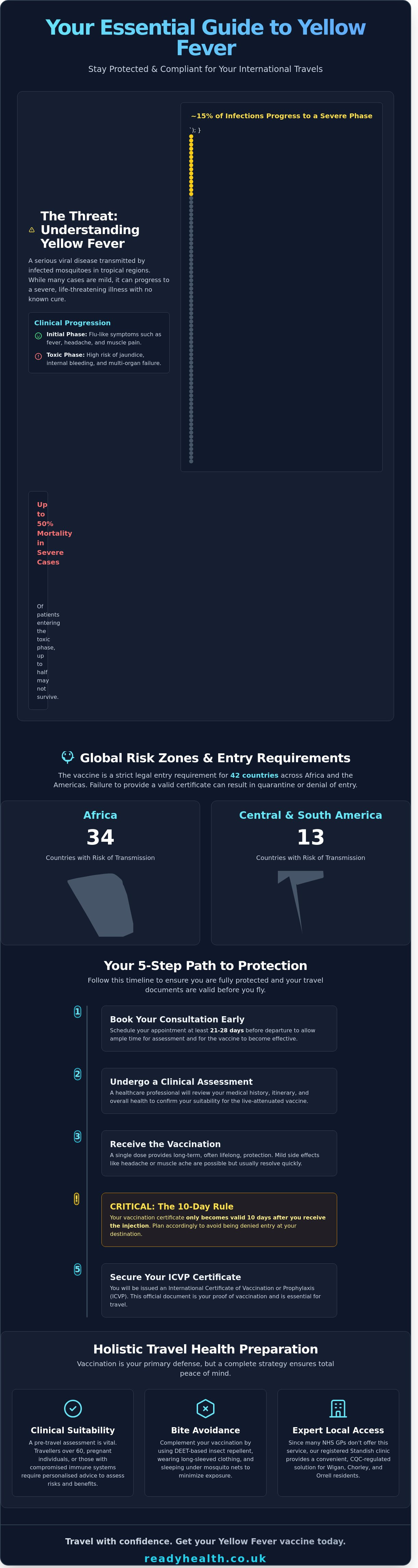
Yellow fever is a serious viral haemorrhagic disease that poses a significant threat to unprotected travellers. It's transmitted to humans through the bite of infected Aedes and Haemagogus mosquitoes, which thrive in both tropical rainforests and crowded urban environments. While many people experience mild symptoms, the World Health Organization (WHO) reports that approximately 15% of those infected progress to a severe, life-threatening phase within 24 hours of initial recovery.
The geographic risk is concentrated in specific endemic zones, primarily across 34 countries in sub-Saharan Africa and 13 countries in Central and South America. Even if you've visited tropical regions before without issue, your previous safety doesn't guarantee future immunity. Each trip requires a fresh assessment of your "Readiness" to ensure your health remains a priority while you explore the world.
To better understand how this clinical protection works, watch this helpful video:
Securing a yellow fever vaccine serves a vital dual purpose. It provides essential personal health protection against a virus with no known cure and ensures you comply with international health regulations. Many countries require an International Certificate of Vaccination or Prophylaxis (ICVP) for entry, especially if you're arriving from an endemic area. Without this official documentation, you may face mandatory quarantine or be refused entry at the border.
The Reality of Yellow Fever Risk
The clinical progression of yellow fever can be unpredictable. Initial symptoms often mirror a mild flu, including fever, headache, and muscle pain. However, the secondary "toxic" phase is far more dangerous, often leading to jaundice, internal bleeding, and multi-organ failure. Research suggests that up to 50% of patients who enter this severe stage succumb to the illness within 7 to 10 days. Yellow fever is a mosquito-borne viral infection that is preventable only through vaccination and bite avoidance.
Why Local Wigan Residents Choose Private Clinics
Many residents in Wigan find that their local NHS GP surgeries don't offer the yellow fever vaccine as a standard service. Because the vaccine requires specific storage conditions and the clinic must be a registered Yellow Fever Vaccination Centre, access can be limited. This often leaves travellers searching for reliable alternatives that fit into their busy schedules.
Choosing a private clinic in Standish provides a convenient and professional solution for those living in Shevington, Chorley, and Orrell. Instead of travelling into Manchester or Liverpool, you can access expert clinical advice right on your doorstep. We focus on proactive health, ensuring you're fully prepared for your journey with the correct documentation and clinical protection. Our goal is to bridge the gap between your travel aspirations and the medical requirements needed to reach your destination safely.
This article is for informational purposes only and does not constitute medical advice. Please consult a qualified healthcare professional before making any health decisions.
The Yellow Fever Vaccination Process: The 10-Day Rule and Your Certificate
Securing your biological readiness for a tropical destination involves more than just a quick injection. The yellow fever vaccine follows a specific clinical and legal protocol that ensures you're both protected from the virus and compliant with international health regulations. At our Standish clinic, we guide you through this five-step journey to make your preparation as seamless as possible.
- Step 1: Book your consultation early. You should aim to schedule your appointment at a registered Wigan centre at least 21 to 28 days before your departure. This timeframe allows us to review your full itinerary and manage any potential interactions with other travel medications.
- Step 2: Undergo a clinical assessment. Because this is a live-attenuated vaccine, our practitioners must confirm it's safe for your specific health profile. We pay close attention to travellers over the age of 60 or those with weakened immune systems to ensure the benefits outweigh any risks.
- Step 3: Receive the injection. The vaccine is administered as a single 0.5ml dose into the deltoid muscle of your upper arm. It's a swift procedure designed to stimulate a robust, long-lasting immune response.
- Step 4: Collect your ICVP. Once the clinician administers the dose, you'll receive your International Certificate of Vaccination or Prophylaxis (ICVP). This document is your official proof of immunisation, featuring a unique clinic stamp and the date of administration.
- Step 5: Observe the 10-day rule. Your body requires time to develop protective antibodies. Legally, the vaccine isn't considered valid for border entry until 10 full days have passed since the injection.
Understanding the ICVP (International Certificate of Vaccination)
The ICVP is a vital legal document required for entry into many countries across Sub-Saharan Africa and South America. According to NHS yellow fever vaccination advice, this certificate acts as a medical passport that border officials scrutinise upon arrival. A significant change occurred in July 2016 when the World Health Organization announced that the yellow fever vaccine now provides life-long protection. This means your certificate doesn't expire after 10 years as it once did; it remains valid for the rest of your life. If you lose your original document, don't panic. If you were vaccinated at our Wigan clinic, we can often issue a replacement by referencing our secure patient records, though an administrative fee may apply.
Timing Your Appointment in Standish
The 10-day window is a non-negotiable requirement for international travel. Border officials at your destination will count the days from your injection date; if you arrive on day nine, you could face mandatory quarantine or be refused entry entirely. We've seen travellers face significant stress due to late bookings, so we recommend prioritising this appointment as soon as your flights are confirmed. For those currently planning their trip, you can view our prices to help structure your travel budget. If you're a last-minute traveller in the Wigan area, contact us immediately. While we'll always try to accommodate urgent requests, the 10-day biological clock cannot be sped up. Being proactive ensures you're fully prepared for the demands of your journey without the worry of border delays.
Taking these steps ensures you're not just reacting to travel requirements, but actively optimising your health for the adventures ahead. If you're ready to start your journey, you can book your consultation online with our expert team today.
Clinical Suitability: Who Can and Cannot Have the Vaccine?
Your readiness for international travel begins with a clear understanding of your clinical profile. The yellow fever vaccine is generally recommended for most travellers aged between 9 months and 60 years. Because this is a live-attenuated vaccine, it contains a weakened version of the virus to stimulate your immune response. This approach is highly effective for long term protection, but it requires a healthy immune system to process the dose safely and effectively.
One of the most frequent questions we encounter at our clinic is whether someone is too old for the jab. While 60 is often cited as a threshold, it isn't an automatic disqualification. Instead, it's a point where our clinicians perform a more detailed risk-benefit analysis. We look at your specific destination, the prevalence of the virus in that region, and your overall vitality. Our goal is to ensure you're fully prepared for your adventure without taking unnecessary risks with your baseline health.
Certain medical conditions require a more cautious approach during your consultation. If you have a history of thymus gland issues, such as thymoma or surgical removal of the thymus, the vaccine is usually avoided. Similarly, individuals with severely weakened immune systems due to treatments like chemotherapy or high dose steroids may not be suitable candidates. You can find more detailed NHS information on Yellow Fever vaccination regarding these specific medical exclusions to help you prepare for your appointment.
Transparency about allergies is vital for a safe vaccination experience. The yellow fever vaccine is cultured in chicken eggs, which means it contains small amounts of egg protein. If you've ever had an anaphylactic reaction to eggs, you must disclose this during your Wigan consultation. We prioritise your safety by assessing the severity of any past reactions before proceeding with the immunisation ritual.
Precautions for Specific Groups
Expectant mothers or those breastfeeding and travelling from Lancashire should ideally delay travel to high risk areas. If travel is essential, we conduct a thorough assessment to determine if the benefits of protection outweigh the potential risks to the baby. For travellers over 60, we specifically monitor for rare but serious reactions known as neurological or viscerotropic disease. If we determine that the vaccine isn't safe for you, our clinicians can issue a 'Certificate of Medical Exemption' to satisfy entry requirements for your destination.
Managing Potential Side Effects
Most people tolerate the vaccine well and feel ready to travel shortly after their appointment. You might experience a mild headache, muscle aches, or slight soreness at the injection site. These are normal signs that your immune system is responding to the yellow fever vaccine. We recommend using paracetamol to manage any post-vaccination discomfort; it's a simple way to maintain your daily routine while your body builds its defences. If you feel significantly unwell or experience a high fever after your jab, you should contact our private GP in Wigan for a professional review of your symptoms.
Beyond the Jab: Holistic Travel Health Preparation
Securing your yellow fever vaccine is a vital milestone in your holiday planning, yet it's only one component of a robust travel health strategy. We view clinical readiness as a multi-layered shield; the injection provides the foundation, but your daily habits on the ground provide the necessary reinforcement. Relying solely on a single jab can leave you vulnerable to other regional health risks that vaccines don't cover. True vitality while abroad comes from a proactive mindset that anticipates environmental challenges before they arise.
Mosquito bite avoidance is your primary line of defence against non-vaccinable diseases like Zika or Dengue fever. You should invest in high-quality repellent containing at least 50% DEET and pack lightweight, long-sleeved clothing to wear during peak biting times at dawn and dusk. Statistics from the London School of Hygiene & Tropical Medicine suggest that using insecticide-treated bed nets can reduce the risk of insect-borne illness by over 70% in high-risk rural areas. These physical barriers are essential because the yellow fever vaccine specifically targets one virus, leaving you unprotected against other tropical pathogens carried by the same insects.
Your consultation at our Wigan clinic will also address other critical immunisations. Depending on your itinerary, we may recommend protection against Hepatitis A, Typhoid, or Rabies. Rabies is a particular concern in many popular destinations; it carries a nearly 100% fatality rate once symptoms appear, making pre-exposure shots a wise investment for many travellers. It's also vital to distinguish between viral protection and parasitic risks. Malaria requires a different approach entirely; you'll typically need a course of prophylactic tablets. Even with a valid yellow fever certificate, malaria remains a significant threat in over 90 countries, making these daily tablets a non-negotiable part of your travel kit.
The Importance of Pre-Travel Blood Tests
Peak physical performance is necessary for navigating long flights and humid climates. Undergoing a Well Man or Well Woman check before you depart allows us to identify underlying deficiencies that might sap your energy. We often suggest checking vitamin D and B12 levels to ensure your immune system is primed for the stresses of travel. You can explore our full range of blood test packages to get a comprehensive snapshot of your current health status, ensuring your body is as ready as your passport.
Travel Health for Chronic Conditions
Managing a long-term condition requires precise planning when crossing multiple time zones. If you take regular medication, our Wigan clinicians can assist with scheduling doses to maintain stable blood levels throughout your journey. We can also provide private prescriptions for "just in case" items, such as antibiotics for severe traveller’s diarrhoea or altitude sickness relief. Being prepared for the physical demands of high-risk destinations means having a tailored medical kit that reflects your specific health profile and maintains your daily ritual of wellness.
Booking Your Yellow Fever Vaccine at Ready Health in Wigan
Securing your yellow fever vaccine shouldn't be a source of pre-travel stress. Our clinic in Standish is strategically situated just 2 miles from Junction 27 of the M6 and a 10-minute drive from Wigan town centre, making us a convenient hub for the entire borough. We operate within a strictly CQC-regulated environment, which means our facility is regularly inspected to ensure we meet the highest national standards for safety, effectiveness, and patient care. While many local GP surgeries currently have wait times exceeding 21 days for travel health appointments, we prioritise accessibility. Most of our clients secure a consultation within 48 hours of their initial enquiry.
The experience at Ready Health is designed to feel like a professional wellness partnership rather than a cold, clinical transaction. You'll spend time with a dedicated practitioner who understands the specific health risks associated with your destination. We've supported over 1,200 local travellers in the last 12 months, providing the clinical foundation needed for safe and confident exploration. We see ourselves as a vital part of the Wigan community, acting as a forward-thinking guide for those who value their long-term vitality as much as their holiday memories.
Our consultations are thorough and unhurried. We focus on the "why" behind every recommendation, ensuring you feel informed and empowered. This proactive approach to health means you aren't just getting a jab; you're gaining a comprehensive understanding of how to maintain your wellbeing in different climates and environments. By choosing a local specialist, you ensure that your documentation is precise and your protection is science-backed.
What to Bring to Your Wigan Appointment
To ensure your 20-minute consultation is as productive as possible, you'll need to have a few specific details to hand. Your travel itinerary is the most critical document; we need to know your exact dates and the specific regions or cities you plan to visit. This is vital because the risk levels for certain diseases can change significantly even within a single country. If you're visiting a rural area in a high-risk zone, our advice will differ from a city-based business trip.
Please also bring any previous vaccination records you have, including your childhood immunisation history if it's available. This prevents you from receiving unnecessary booster doses and helps us build an accurate picture of your current immunity. Finally, bring a clear list of any medications you're currently taking. Some treatments can interact with the yellow fever vaccine, so our clinicians need this data to ensure the procedure is safe for your specific biological profile.
Ready for Your Adventure
True peace of mind comes from knowing you've done the hard work of preparation before you even reach the airport. By choosing expert clinical preparation, you remove the "what-ifs" from your travel plans. We're here to ensure that your body is as ready for the journey as your suitcase is. Beyond essential vaccinations, many of our clients choose to integrate vitamin injections into their pre-holiday ritual. These injections are formulated for high bioavailability, helping to boost your energy levels and immune resilience before a long-haul flight.
Don't leave your health to the last minute. Book a comprehensive travel consultation today to ensure you're fully 'Ready' for your next great escape. Our team is standing by to provide the professional guidance and clinical excellence you deserve.
Secure Your Health for Your 2026 Adventure
Your journey toward a safe and vibrant travel experience starts with proactive preparation. You should remember that the yellow fever vaccine requires administration at least 10 days before your departure to ensure your International Certificate of Vaccination or Prophylaxis is legally valid for entry. Our expert clinicians help you navigate this critical timeline while assessing your personal health history to ensure every treatment is appropriate for your specific needs.
At Ready Health, we prioritise your readiness by offering a sophisticated clinical service that values your time. As a CQC-regulated private clinic located in Standish, we provide a seamless experience with easy parking and tailored advice that extends beyond basic requirements. We've refined our process to ensure Wigan travellers can access high-quality care without the stress of long wait times or complex booking systems.
Book your travel vaccination consultation at Ready Health in Wigan today to ensure you're fully prepared for the demands of your next destination. We're here to help you step onto that plane with total peace of mind.
This article is for informational purposes only and does not constitute medical advice. Please consult a qualified healthcare professional before making any health decisions.
Frequently Asked Questions
How much does the yellow fever vaccine cost in Wigan?
The yellow fever vaccine typically costs between £70 and £85 at private clinics across the Wigan area. This investment covers your clinical consultation, the administration of the jab, and the official International Certificate of Vaccination or Prophylaxis (ICVP). At Ready Health, we provide clear, upfront pricing so you can manage your travel budget with total confidence and no hidden surprises.
How long before I travel do I need to get the yellow fever jab?
You need to receive your vaccination at least 10 days before you arrive in a high-risk area. This specific timeframe is a legal requirement under International Health Regulations to ensure your certificate is valid for entry at the border. From a clinical perspective, it also gives your body the necessary time to build a robust immune response, ensuring you're fully protected before you reach your destination.
Does the yellow fever vaccine last for life?
Yes, for the vast majority of travellers, a single dose of the yellow fever vaccine provides lifelong protection against the virus. The World Health Organization (WHO) updated their guidelines in July 2016, stating that booster doses are no longer required for international travel. Once you've received your injection and certificate, it remains valid for the rest of your life without the need for further doses.
Can I get the yellow fever vaccine on the NHS?
You can't usually get this specific vaccination on the NHS because it's classified as a travel health service rather than a routine public health requirement. While some GP surgeries are registered centres, they'll still charge a private fee for the service. Most people in Wigan choose a dedicated private clinic to benefit from flexible appointment times and a more comprehensive pre-travel health assessment.
What happens if I cannot have the yellow fever vaccine for medical reasons?
If you're medically unable to have the vaccine, perhaps due to being over 60 or having a specific immune condition, our clinicians can issue a Medical Exemption Certificate. This document explains your situation to border officials in a professional capacity. It's important to remember that some countries may still require you to quarantine, so we recommend checking the specific entry rules for your destination 6 weeks before you fly.
Are there any side effects to the yellow fever injection?
Most people experience only mild reactions, such as a slight headache or muscle aches, which affect approximately 10% to 30% of recipients. These symptoms typically appear within the first 5 days after the jab and resolve quickly without intervention. Serious complications are extremely rare, occurring in fewer than 1 in 100,000 cases, but our team will always discuss your full medical history to ensure the treatment is safe for you.
Do I need a yellow fever certificate for a layover in a risk country?
You may need a certificate for a layover if you spend more than 12 hours in an airport located in a high-risk country. Some nations enforce this rule even for shorter transits to prevent any potential spread of the virus. It's vital to check the latest requirements on the NaTHNaC (National Travel Health Network and Centre) website or speak with our team to ensure your documentation is correct.
Where is the best place to get a yellow fever vaccine in Standish?
Ready Health in Standish is a premier choice for those seeking a professional and efficient vaccination experience. Our clinic is a registered Yellow Fever Vaccination Centre, meaning we're authorised to administer the jab and provide the official certification you need for your journey. We focus on your total readiness, ensuring you're protected and prepared for your upcoming adventure with expert clinical guidance.
This article is for informational purposes only and does not constitute medical advice. Please consult a qualified healthcare professional before making any health decisions.

Article by
Shamir Patel
Shamir Patel is a UK-based Clinical Pharmacist and Independent Prescriber with a specialist focus on ADHD and weight management.
He is the Registered CQC Manager at Ready Health Medical Clinic, where he leads the development and delivery of safe, patient-centred services across ADHD assessment and treatment, weight loss programmes, and general medical care.
With a career spanning nearly three decades since qualifying in 1995, Shamir brings extensive clinical and operational experience across both community pharmacy and private healthcare.
He also serves as Deputy Superintendent Pharmacist and Lead Prescriber at PillSorted. He oversees high-volume prescribing services. He focuses on GLP-1 weight loss treatments and clinical governance.
Shamir is a SCOPE-accredited obesity specialist and has a strong interest in improving access to evidence-based ADHD care. He is known for his structured, guideline-driven approach, aligning his clinical practice with NICE recommendations and regulatory standards set by the GPhC and CQC.
Alongside his clinical work, Shamir is actively involved in mentoring prescribing pharmacists, developing standard operating procedures, and contributing to service innovation within digital and community healthcare settings. His work reflects a commitment to safe prescribing, patient education, and improving outcomes through practical, accessible care.
Disclaimer
The information on this website is provided for general educational and informational purposes only and is not intended as medical advice, diagnosis, or treatment. Articles reflect general guidance and may not be suitable for your individual circumstances. You should always seek advice from a qualified healthcare professional before starting, stopping, or changing any treatment, medication, or healthcare plan. While we aim to keep our content accurate and up to date, Ready Health makes no guarantees about the completeness, accuracy, or suitability of the information provided. Reliance on any information on this site is entirely at your own risk. If you have concerns about your health, please book an appointment with a suitably qualified clinician. In an emergency, contact 999 or attend your nearest A&E department.


