

If you’re looking for a fast track ADHD diagnosis near me, it helps to know what a private assessment involves and how to prepare. “Fast-track” can describe a different route to assessment, but it does not guarantee an appointment date or diagnosis. This guide explains what to expect and what to consider when choosing a route in Wigan.
Key Takeaways
- A private ADHD assessment is a different access route from NHS care, with its own arrangements and follow-up considerations.
- A clinician may discuss your history and current difficulties, review relevant information and share their feedback.
- To prepare for a fast track ADHD diagnosis near me, note examples of difficulties, when they happen and how they affect everyday life.
- ADHD assessment considers more than a questionnaire. The information you share helps build a broader picture for clinical discussion.
- Ready Health offers ADHD assessment and diagnosis for adults and children in Standish, Wigan, alongside an online assessment route.
Fast-track ADHD diagnosis near me: what the phrase really means
“Fast-track” can sound like a promise of a set appointment, quick report or confirmed diagnosis. It is not. The phrase usually refers to choosing a private assessment route that may offer access sooner than another pathway. Appointment timing and the clinical outcome depend on individual circumstances.
A private ADHD assessment may offer a different route to clinical evaluation, but it cannot guarantee an appointment date or an ADHD diagnosis. If you’re searching for a fast track ADHD diagnosis near me, separate access from outcome: an assessment gives you the opportunity to discuss your experiences with a clinician, not a pre-decided result.
ADHD is a neurodevelopmental condition, meaning it relates to how the brain develops and functions. It can affect attention, activity levels or impulse regulation. A clinician considers the broader pattern and its impact, rather than treating one difficulty, such as losing focus at work, as proof of ADHD.
When might you consider an ADHD assessment?
You might seek advice if difficulties with attention, organisation, restlessness or impulsive actions persist and affect everyday life. For example, you may find it hard to manage tasks at work and household responsibilities, or notice similar challenges in more than one setting. These experiences can have different explanations, so they are a reason to discuss your concerns, not to diagnose yourself.
Adults sometimes seek an assessment after recognising longstanding patterns that have become more noticeable as work, relationships or family responsibilities change. If you are a parent, professional advice may be helpful when concerns about your child’s attention, activity or impulses are affecting daily life at home or school.
What fast-track can and cannot promise
A private route may make an assessment accessible sooner, but “fast-track” alone does not establish how soon an appointment or written feedback will be available. It also does not mean a clinician will reach a particular conclusion. The assessment needs to consider your history, current difficulties and relevant context before an outcome is discussed.
An online quiz may help you organise questions or recognise patterns you want to raise, but it cannot confirm ADHD. One symptom, a checklist result or a brief conversation is not a diagnosis. A fuller clinical assessment helps distinguish ADHD from other possible explanations for the difficulties you describe.
Ready Health offers ADHD assessment and diagnosis for adults and children in Standish, Wigan, as well as an online ADHD assessment. Whichever format you explore, prepare to describe what you have noticed and how it affects you, while allowing the clinician’s assessment to guide the outcome.
What happens during a private ADHD assessment?
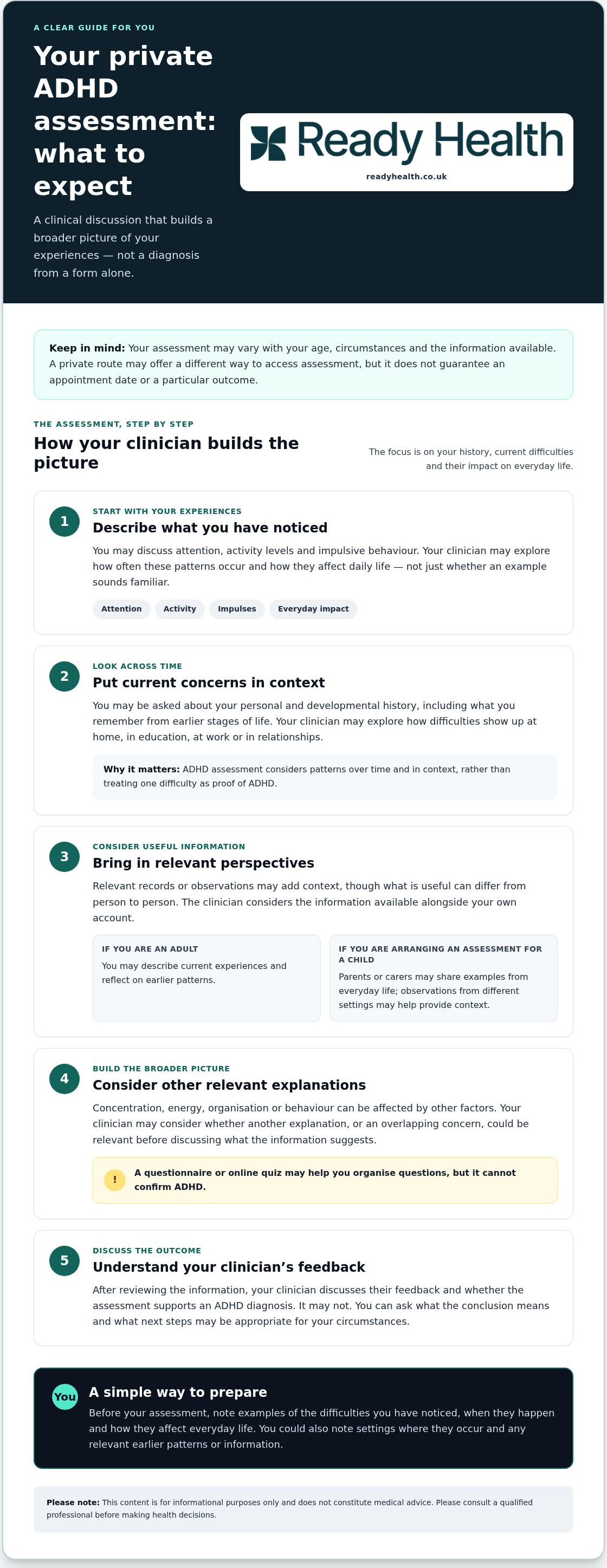
A private ADHD assessment is a clinical process, not simply a score from a form. The clinician gathers information, discusses your experiences, considers relevant evidence and explains their conclusions. The process can vary with your age, circumstances and the information available, so this is a general guide rather than a fixed appointment script.
The NICE Guidelines for ADHD Diagnosis and Management describe assessment in terms of a full clinical and psychosocial evaluation, including developmental history. In plain language, this means looking at how difficulties have developed over time and how they relate to your life, rather than relying on one symptom or a single source of information.
Information a clinician may explore
You may be asked about attention, activity levels and impulsive behaviour, as well as how these experiences affect daily life. For example, a clinician may explore whether you often lose track of tasks, feel driven to move or act quickly in ways that cause difficulty. The discussion considers how often these patterns occur and their impact, not just whether they sound familiar.
Your personal and developmental history can put current concerns into context. A clinician may ask what you remember from earlier stages of life and how difficulties have appeared in settings such as education, work, home or relationships. Relevant records or observations may add context, although what is useful can differ from person to person.
Other factors can affect concentration, energy, organisation or behaviour. The clinician may consider whether another explanation, or an overlapping concern, could be relevant. This helps avoid treating every difficulty as evidence of ADHD and supports a considered discussion of what the information suggests.
How assessment can differ for adults and children
Age and developmental stage shape how a clinician gathers and interprets information. An adult may describe current experiences and reflect on earlier patterns, while a child’s assessment may draw on observations from people who know them in different settings. Parents or carers can contribute examples of a child’s everyday functioning.
There is no single account or assessment approach that fits everyone. A child’s needs, communication style and circumstances may affect how information is explored, just as an adult’s history and current life context may guide the discussion. The clinician considers the individual picture rather than assuming one person’s process applies to another.
After reviewing the information, the clinician discusses their feedback and whether the assessment supports an ADHD diagnosis. It may not. You can use the conversation to clarify what the conclusion means and what next steps may be appropriate for your circumstances.
If you’re considering a fast track ADHD diagnosis near me, understanding the process can help you prepare without expecting a predetermined outcome. Ready Health offers ADHD assessments for adults and children in Standish, Wigan. You can explore booking options as a practical next step.
Private ADHD assessment versus the NHS: compare the routes carefully
Choosing between NHS and private assessment involves more than comparing how soon you might be seen. Consider how each route is accessed, how costs fit your circumstances and what support you may need afterwards. The right choice depends on your needs and the arrangements available to you.
| Route | Access arrangements | Payment | Follow-up to consider |
|---|---|---|---|
| NHS | Usually begins with speaking to your GP or another healthcare professional about referral. Local arrangements and access can change. | NHS care is provided through NHS services. | Ask how assessment outcomes and any treatment recommendations are managed within your local pathway. |
| Private | You arrange and pay for an assessment directly with a private service. Timing depends on that service’s arrangements. | You pay privately for the assessment and should consider any possible ongoing costs. | Clarify what follow-up may involve and how any treatment recommendations relate to your NHS care. |
For an explanation of the public pathway, the NHS outlines its ADHD diagnosis process. If you’re considering a private assessment, weigh whether a different access route fits your priorities and budget. Neither pathway is automatically right for everyone. Access arrangements can change, so use current NHS guidance when considering the route available to you.
Questions to consider about each route
Before deciding, think about what matters most to you: access, continuity with existing care, cost, or the ability to plan around work, study or family commitments. You might also consider whether you want to explore treatment after assessment and how you would manage that conversation with your GP or relevant NHS service.
Private assessment does not guarantee NHS prescribing or a shared-care arrangement. Shared care means an NHS professional agrees to take on part of ongoing care, such as prescribing. That agreement depends on the relevant professionals and local arrangements, and a private diagnosis does not automatically transfer into NHS care.
Diagnosis, treatment and shared-care expectations
An assessment outcome and a decision about medication are separate steps. A clinician may discuss options based on your individual circumstances, but an ADHD diagnosis does not mean medication is required or suitable. If medication is considered, ask who would oversee treatment, how monitoring would work and what arrangements might apply if NHS care is involved.
These are practical questions, not reasons to expect a particular outcome. Understanding the distinction can help you compare routes realistically, including the possibility that NHS services may review information or follow their own processes before agreeing to ongoing care.
If private assessment is the route you’re exploring, you can view Ready Health booking options and consider how an assessment could fit your needs.
How to prepare for an ADHD assessment near Standish or Wigan
You do not need to arrive with a perfect timeline or every answer prepared. A few clear examples can help you explain what you have noticed and how it affects day-to-day life. If you’re considering a fast track ADHD diagnosis near me, preparation is about helping the clinician understand your experiences, not building a case for a particular outcome.
Before an appointment in or around Standish and Wigan, jot down notes or ask someone you trust to help you remember relevant examples. Share information you feel comfortable discussing, and ask the clinician how personal details are used in the assessment if you have questions.
What to note before the appointment
Think about patterns over time, not just what happened this week. Brief, real-life examples may be more useful than general descriptions such as “I’m disorganised”. You could note:
- Situations where you find it hard to focus, follow instructions or finish tasks.
- Examples of difficulties with planning, remembering appointments or keeping track of belongings.
- Times when restlessness or acting quickly has caused difficulty.
- When you first remember these concerns and whether they have changed over time.
- How they affect work, study, relationships, household responsibilities or other parts of daily life.
You do not need to decide whether an example is significant. Note what happened, where it happened and what the impact was. It can also help to include situations where you manage well, giving the clinician a fuller picture of your strengths and challenges.
If the assessment is for your child, you might note observations from home and, where appropriate, school. For example, record when your child struggles to follow routines or stay focused on activities, and what seems to help. Share information from other people sensitively and with regard for your child’s privacy.
Questions that can make the appointment clearer
Writing down questions in advance can help you make good use of the discussion. You might ask what the assessment involves, what information would be useful, how feedback is shared and what follow-up options may apply. You can also ask how any recommendations relate to your circumstances.
If you have broader concerns about your mental health alongside possible ADHD, our guide to a private mental health assessment in Wigan may help you consider what you would like to discuss. You do not need to resolve every question beforehand; raising uncertainties is part of the conversation.
Ready Health provides ADHD assessment and diagnosis for adults and children in Standish, Wigan. If you have gathered the information that feels relevant and are ready to explore a next step, you can view booking options.
Ready Health ADHD assessments: local and online next steps
If you’re considering an assessment, the next step is to decide which route may suit your circumstances and what you want to understand. Ready Health offers ADHD assessment and diagnosis for adults and children at its clinic in Standish, Wigan, as well as an online assessment option. The format that suits you depends on your individual situation.
An assessment is a clinical process, and its outcome depends on the information available and your circumstances. It may support an ADHD diagnosis, or the clinician may discuss another explanation or further considerations. Any subsequent care will also depend on your needs and the clinical recommendations made. A faster route to assessment is not a promise of a particular conclusion, treatment or timeframe.
Local and online ADHD assessment options
Ready Health’s clinic in Standish, Wigan, provides a local point of access for ADHD assessments for adults and children. The clinic is relevant to people in Wigan and nearby communities, including Shevington, Standish Lower Ground, Boar's Head, Wrightington, Appley Bridge, Chorley, Skelmersdale, Orrell, Ashton-in-Makerfield, Bolton, Leigh, Preston, Southport and St Helens. You can also explore the online ADHD assessment information.
Before choosing a route, think about what would help you take part comfortably. You may prefer to attend the clinic, or you may want to explore the online information first. Consider what you need to discuss, any questions about the assessment and how you would like to receive feedback. These are useful points to raise as you plan your next step.
Choose a clear next step
If you’re exploring a fast track ADHD diagnosis near me, focus on access to a careful assessment rather than expecting a guaranteed diagnosis. Reflecting on your concerns and considering what you would like to ask are useful preparation. Your next step can simply be learning more about the service and deciding whether you are ready to arrange an assessment.
Ready Health’s ADHD service helps you explore your concerns with a clinician. Whether the assessment is for you or your child, the conclusions and any discussion of follow-up depend on the individual clinical picture. You can book a consultation or explore the online assessment information before deciding.
Take your next step with confidence
Searching for a fast track ADHD diagnosis near me can be the start of a clearer conversation about what you’re experiencing. You do not need to have everything worked out before taking that step. An assessment can help you understand the options available to you, whether or not it leads to an ADHD diagnosis.
Move at a pace that feels manageable. Consider what you would like to understand, note any questions that matter to you, and explore the service before deciding whether to proceed. There is no need to assume an outcome in advance.
Book a Ready Health consultation to explore an ADHD assessment in Standish, Wigan, or visit Ready Health’s website to learn more about its services.
Frequently Asked Questions
What does fast-track ADHD diagnosis mean?
Fast-track usually refers to seeking a private assessment route that may provide access sooner than an NHS pathway, but it does not promise a particular appointment date or diagnosis. The phrase describes the route, not the clinical result. If you’re considering a fast track ADHD diagnosis near me, focus on understanding what the assessment involves and what happens after the clinician has considered your information.
Can adults get a private ADHD diagnosis in Wigan?
Yes. Ready Health offers private ADHD assessment and diagnosis for adults at its clinic in Standish, Wigan. An assessment is an opportunity to discuss your concerns with a clinician, and the outcome depends on the individual clinical evaluation. Before arranging an assessment, consider what you would like to clarify, such as how your difficulties affect work, home life or relationships, and note any questions you want to raise.
Can children have a fast-track ADHD assessment?
Children can have a private ADHD assessment through Ready Health’s service for adults and children. The assessment may take account of a child’s age, development and individual circumstances. Parents or carers can think about examples from everyday routines, learning and interactions that may help explain their concerns. An assessment does not guarantee a diagnosis, and the outcome depends on the clinician’s evaluation.
Does a private ADHD diagnosis mean the NHS will prescribe medication?
No. A private diagnosis does not automatically mean an NHS clinician will prescribe medication or take over ongoing care. Prescribing and shared care involve separate clinical decisions, and shared care requires agreement from the relevant NHS professionals. If you’re considering medication, it may help to understand who would oversee treatment and what follow-up could involve before making plans based on an assessment outcome.
What should I bring to an ADHD assessment?
There is no set list of items everyone must bring. You could take brief notes about examples that are easy to forget, such as missed deadlines, difficulty following conversations or challenges with daily routines. If you have relevant information about your history, you may find it useful to have it available. A short list of questions can also help you remember what you want to discuss.
Can an online ADHD assessment provide a diagnosis?
An online assessment may be part of a clinical assessment, but whether it is suitable for you and what conclusion can be reached depend on your circumstances and the information available. Ready Health offers an online ADHD assessment. Online access does not make a diagnosis automatic: a clinician must consider your individual situation before discussing an outcome or possible next steps.
How long does a fast-track ADHD assessment take?
There is no single timeframe that applies to every private assessment. Appointment length, time to access an appointment and time to receive feedback are different things, and each may depend on the assessment pathway and your circumstances. Rather than assuming “fast-track” means a set number of days, consider what timing you need to plan around and what you want clarified before proceeding.
If you’re ready to explore your options, visit Ready Health’s website to learn more about its ADHD assessment service and book a consultation.
This content is for informational purposes only and does not constitute medical advice. Consult a healthcare professional before making decisions about your health.

Article by
Shamir Patel
Shamir Patel is a UK-based Clinical Pharmacist and Independent Prescriber with a specialist focus on ADHD and weight management.
He is the Registered CQC Manager at Ready Health Medical Clinic, where he leads the development and delivery of safe, patient-centred services across ADHD assessment and treatment, weight loss programmes, and general medical care.
With a career spanning nearly three decades since qualifying in 1995, Shamir brings extensive clinical and operational experience across both community pharmacy and private healthcare.
He also serves as Deputy Superintendent Pharmacist and Lead Prescriber at PillSorted. He oversees high-volume prescribing services. He focuses on GLP-1 weight loss treatments and clinical governance.
Shamir is a SCOPE-accredited obesity specialist and has a strong interest in improving access to evidence-based ADHD care. He is known for his structured, guideline-driven approach, aligning his clinical practice with NICE recommendations and regulatory standards set by the GPhC and CQC.
Alongside his clinical work, Shamir is actively involved in mentoring prescribing pharmacists, developing standard operating procedures, and contributing to service innovation within digital and community healthcare settings. His work reflects a commitment to safe prescribing, patient education, and improving outcomes through practical, accessible care.
Disclaimer
The information on this website is provided for general educational and informational purposes only and is not intended as medical advice, diagnosis, or treatment. Articles reflect general guidance and may not be suitable for your individual circumstances. You should always seek advice from a qualified healthcare professional before starting, stopping, or changing any treatment, medication, or healthcare plan. While we aim to keep our content accurate and up to date, Ready Health makes no guarantees about the completeness, accuracy, or suitability of the information provided. Reliance on any information on this site is entirely at your own risk. If you have concerns about your health, please book an appointment with a suitably qualified clinician. In an emergency, contact 999 or attend your nearest A&E department.


