

For a medical report for an insurance claim in Preston, an insurer may request a report or supporting letter when assessing an application or reviewing a claim. For a personal injury claim, the report can describe your injuries, their effect on work and daily life, and your expected recovery.
It’s understandable to want clarity about who prepares the report and how your health information is handled. This guide explains when a report may be needed, who can provide it, and how consent and disclosure work, so you know what to expect.
Key Takeaways
- Learn when an insurer may need a medical report and what health records or identity details can support an access request.
- Understand how consent affects the disclosure of medical information, including the 21-day wait for a life assurance report you’ve asked to see first.
- See how GPs and hospitals may be involved in insurance claims, and why the right report depends on the purpose of the claim.
- Find out when Ready Health’s medical reports and occupational medicals may be a relevant next step for your needs.
When might you need a medical report?
An insurer may request a medical report when assessing an application or reviewing a claim. For a personal injury claim, it can describe your injuries, recovery and effects on work or daily life. Serious or complex injuries may require reports from several specialists, supported by GP or hospital records.
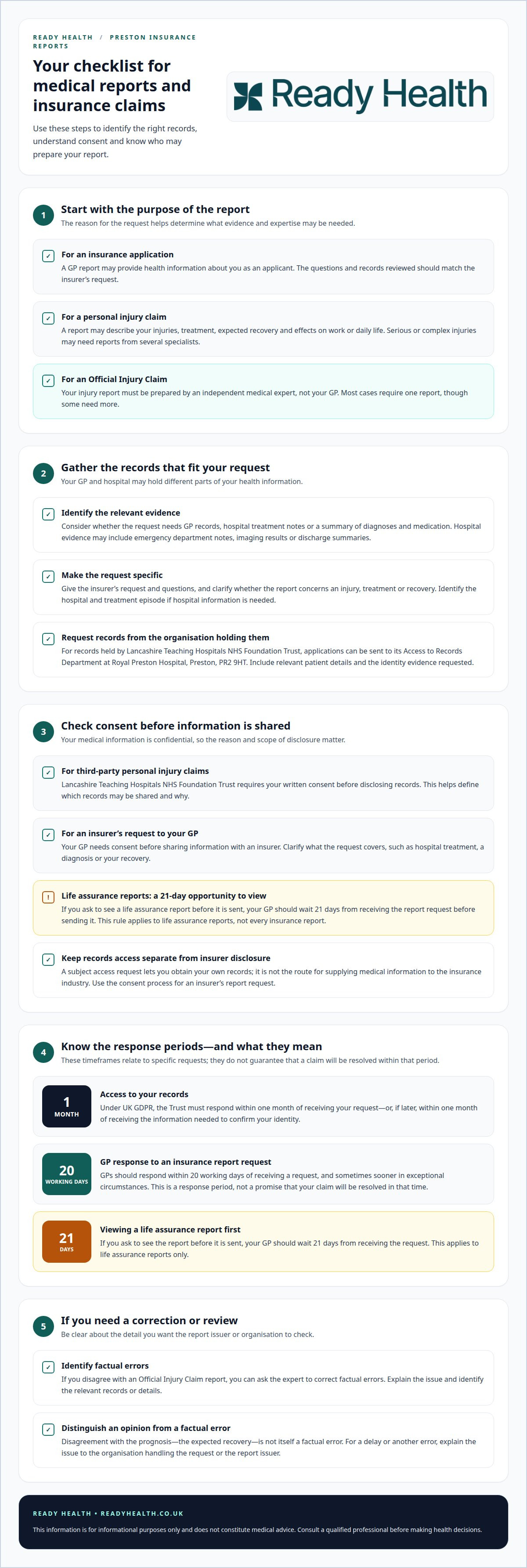
Start by identifying which records the report needs: for example, hospital treatment notes, GP records or a medical summary of diagnoses and medication. Apply to the organisation holding them, such as Lancashire Teaching Hospitals NHS Foundation Trust, and provide information that helps it identify you and confirm your identity. Under the UK General Data Protection Regulation, the Trust must respond within one month of receiving your request or, if later, within one month of receiving the information needed to confirm your identity.
You can send applications to the Trust’s Access to Records Department at Royal Preston Hospital, Preston, PR2 9HT. Include the relevant patient details and identity evidence requested for the application. According to the Access to Health Records Act 1990, certain individuals have a right to access a deceased person’s health record.
You don’t need a solicitor to access your own records. However, an Official Injury Claim report must be prepared by an independent medical expert, not your GP. A solicitor may arrange an expert report for other claims, depending on the claim type.
If you disagree with an Official Injury Claim report, you can ask the expert to correct factual errors. Disagreement with the prognosis, or expected recovery, is not a factual error. To raise a delay or other error, explain the issue to the organisation handling the request or the report issuer, and identify the relevant records or details. This gives them a clear basis to respond or review the information.
Consent and disclosure of medical information
Your medical information is confidential, so an insurer or solicitor needs an appropriate basis to obtain it. For third-party personal injury claims, Lancashire Teaching Hospitals NHS Foundation Trust requires your written consent before disclosing records. This helps define which records may be shared and why.
Consent also matters when an insurer requests information about an illness abroad. GPs need consent before disclosing information to insurers verifying a policyholder’s claim. Clarify the circumstances and scope of the request, such as whether it concerns hospital treatment, a diagnosis or your recovery. This can help the doctor identify relevant information.
Life assurance reports have a specific process. Under the Access to Medical Reports Act 1988, if you ask to see the report before it is sent, your GP should wait 21 days from receiving the report request before sending it. This gives you an opportunity to see the report before disclosure. The rule applies to life assurance reports, not every insurance report.
A subject access request lets you obtain your own records, but it is not the appropriate route for providing medical information to the insurance industry. The British Medical Association’s advice reflects Information Commissioner’s Office guidance on this distinction. Use the consent process for an insurer’s report request rather than relying on a records-access request to supply claim evidence.
If you need to discuss a private medical report or how a clinician can assist, explore private medical report support as a next step.
Claims involving GPs and hospitals
Your GP may hold a history of consultations, diagnoses, prescriptions and referrals relevant to an insurance claim. However, UK GPs generally aren’t required to undertake non-NHS work, apart from limited exceptions. A report about illness abroad, for example, isn’t part of a GP’s required service, and the GP may charge for private work.
For insurance reports, GPs should respond within 20 working days of receiving a request, and sometimes sooner in exceptional circumstances. This is a response period, not a promise that every claim will be resolved within that time. A complete request helps the practice understand the insurer’s questions and identify the records or clinical details being sought.
Hospitals may hold separate evidence, such as emergency department notes, imaging results or discharge summaries after an injury. These records can help establish what treatment you received and when. If a report needs hospital information, those records may need to be obtained separately, affecting how it is prepared. Identify the relevant hospital and treatment episode in the request.
The report’s purpose determines who can prepare it. For an Official Injury Claim, your GP cannot provide the injury report; it must come from an independent medical expert with the required accreditation. The examination is usually arranged through the portal and paid for by the party responsible for covering its cost. For other claims, a solicitor may arrange an expert assessment, with GP or hospital records providing background evidence.
To help a GP respond accurately, provide the insurer’s request and specific questions, and clarify whether it concerns an injury, treatment or recovery. If hospital information is also needed, identify that separately rather than assuming the GP holds every record. This helps establish which clinician or organisation should supply each part of the evidence.
Medical reports for insurance applications and claims
A report for a new insurance application has a different purpose from one for an injury claim. The questions, examination and records reviewed should match the reason for the request.
Reports for applications and claims
For a private medical insurance application, a GP report may provide health information about a person applying for insurance. For an injury claim, it can describe injuries, treatment, expected recovery and effects on work or daily life. An examination lets an expert assess you directly. Most Official Injury Claim cases require one report, though some need more. If you need a medical report for an insurance claim in Preston, check that it addresses the insurer’s questions and accurately records your circumstances.
Report costs and payment responsibility
The cost of a private medical report in Preston depends on the work involved, including its purpose, the records needed and whether an examination is required. Request a quote and agree the fee before work begins. There isn’t one price for every report. For an Official Injury Claim, the compensator (the person or organisation responsible for paying the claim costs) pays for the medical examination, usually arranged through the portal. Other claim routes may have different payment arrangements.
An independent medical examination may form part of an insurance claim. For an Official Injury Claim, it’s usually arranged through the portal. For a Direct Medical Expert appointment, contact the expert before selecting them to discuss arranging an appointment. A medical report for an insurance claim in Preston should address the relevant injuries and expected recovery, rather than serve as a general health assessment.
Takeaway: Match the report to the application or claim, and understand its scope and payment arrangements before proceeding. Discuss your report requirements.
Ready Health: Medical Reports & Occupational Medicals
Ready Health provides medical reports and occupational medicals for people who need clinical documentation for insurance or work-related purposes. The right service depends on what the requesting organisation needs, so first identify the report type and intended use.
Ready Health provides pre-employment medicals, taxi medicals, visa medicals and fit-to-drive assessments for occupational requirements. Personal Independence Payment (PIP), a UK benefit for people with a long-term health condition or disability, reports are also available. These services may suit you when an employer, licensing process or application requires a medical assessment or report. The purpose matters: a taxi medical addresses a different requirement from a report supporting an insurance matter.
Ready Health also provides medical reports and occupational insurance medicals. If your insurer has requested documentation, clarify whether it needs a report, a medical assessment or records from a treating clinician. For an Official Injury Claim, the injury report must come from an independent medical expert with the required accreditation, not your GP. Choose a report service that matches the insurer’s stated requirements.
If you need to discuss a health concern before deciding what documentation is relevant, you can book a private GP consultation. You can choose a 15-minute or 30-minute appointment. A consultation can address your health concerns, while any report or assessment needs to fit the purpose and requirements of your case.
Having the request details to hand can make it easier to explain what you need, such as the report type and who requires it. You can contact Ready Health to discuss your needs.
Take the next step with confidence
Before arranging a report, gather the insurer’s request and note what decision it needs to support. Being clear about the purpose can keep the process focused and make your next conversation more useful.
If you’re considering a medical report for an insurance claim in Preston, Ready Health can help you discuss the appropriate next step for your needs. You can contact Ready Health to talk through your enquiry.
Frequently Asked Questions
How long does it take to receive the report?
There isn’t one timeline for every report. The process may involve arranging an examination, gathering relevant information and preparing the written report. If you’re waiting, ask the person managing your claim which stage it has reached and whether anything is needed from you. This can help distinguish a delay arranging an appointment from the time needed to write the report.
How long will it take to process my request?
Processing depends on what you’ve requested. A copy of existing records differs from a new report that requires a clinician to review your history or assess you. When making the request, specify what you need and who will receive it. This helps the practice identify the right task and explain the next administrative step.
What happens to the report?
The report is used for its stated purpose, such as considering an insurance application or claim. The insurer may weigh its findings alongside other information when assessing the case. If a detail is unclear, the insurer may seek further information through the relevant process. Keep a copy and note any questions about its contents.
How do I request medical records or a report from my GP in Preston?
Contact your GP practice and explain whether you need copies of existing records or a newly prepared report. If the insurer supplied a form or specific questions, mention them when making your request. A records copy and an insurance report serve different purposes, so be precise to help the practice direct your enquiry. Note when you submitted it.
What information and documents do I need to request a medical report?
Have the insurer’s request or form available, along with your claim reference if you have one. Explain who will receive the report and what questions it should address. For an appointment, note relevant dates, treatment and changes in your symptoms since the incident. These details can help the clinician understand the context and focus the assessment on the matter being considered.
How long does it take to get a medical report for an insurance claim?
For an Official Injury Claim, the average was 30 days from selecting a medical expert to the report being uploaded, as of September 2026. This period includes attending the examination. It doesn’t cover earlier claim preparation, and specialist input or outstanding records can affect the overall process. The point at which timing is measured matters when you’re tracking progress.
If you’d like to discuss your medical report needs, contact Ready Health.
This content is for informational purposes only and does not constitute medical advice. Consult a qualified professional before making decisions about your health.

Article by
Shamir Patel
Shamir Patel is a UK-based Clinical Pharmacist and Independent Prescriber with a specialist focus on ADHD and weight management.
He is the Registered CQC Manager at Ready Health Medical Clinic, where he leads the development and delivery of safe, patient-centred services across ADHD assessment and treatment, weight loss programmes, and general medical care.
With a career spanning nearly three decades since qualifying in 1995, Shamir brings extensive clinical and operational experience across both community pharmacy and private healthcare.
He also serves as Deputy Superintendent Pharmacist and Lead Prescriber at PillSorted. He oversees high-volume prescribing services. He focuses on GLP-1 weight loss treatments and clinical governance.
Shamir is a SCOPE-accredited obesity specialist and has a strong interest in improving access to evidence-based ADHD care. He is known for his structured, guideline-driven approach, aligning his clinical practice with NICE recommendations and regulatory standards set by the GPhC and CQC.
Alongside his clinical work, Shamir is actively involved in mentoring prescribing pharmacists, developing standard operating procedures, and contributing to service innovation within digital and community healthcare settings. His work reflects a commitment to safe prescribing, patient education, and improving outcomes through practical, accessible care.
Disclaimer
The information on this website is provided for general educational and informational purposes only and is not intended as medical advice, diagnosis, or treatment. Articles reflect general guidance and may not be suitable for your individual circumstances. You should always seek advice from a qualified healthcare professional before starting, stopping, or changing any treatment, medication, or healthcare plan. While we aim to keep our content accurate and up to date, Ready Health makes no guarantees about the completeness, accuracy, or suitability of the information provided. Reliance on any information on this site is entirely at your own risk. If you have concerns about your health, please book an appointment with a suitably qualified clinician. In an emergency, contact 999 or attend your nearest A&E department.


