

The right therapist is one whose experience with depression, therapeutic approach and appointment format suit your needs. In Chorley, 87% of counsellors prioritise treating depression, giving you a useful starting point when comparing options. Finding private counselling for depression in Chorley means looking beyond location to consider whether you feel comfortable talking with the therapist and whether their way of working feels right for you.
It’s understandable to want a clear idea of what to look for before taking this step. This guide explains how to assess a counsellor’s training and approach, compare face-to-face and online support, and consider how counselling may fit alongside other care. It also covers when counselling may be appropriate and when urgent help is more suitable, so you can make an informed choice at your own pace.
Key Takeaways
- Compare a therapist’s experience with depression, therapeutic approach and session format to find a fit for your needs.
- Insurance acceptance varies: in Chorley, 79% of counsellors accept Bupa, 58% accept Aviva and 53% accept AXA PPP.
- If you’re in a mental health crisis in England, call NHS 111 and select the mental health option, available 24/7. Call 999 if you or someone else has been harmed.
- A Ready Health Private GP Consultation (15 Minutes) may be a useful next step if you want to discuss your mental health with a GP.
Can private counselling for depression be covered by health insurance or employee assistance programmes in the UK?
Private counselling for depression in Chorley may be funded through private health insurance or an employer’s assistance programme. The options depend on your cover: an insurer may fund approved sessions, while an employee assistance programme (EAP) may provide a defined support service through work. Check how each route works before arranging counselling.
How private health insurance may apply
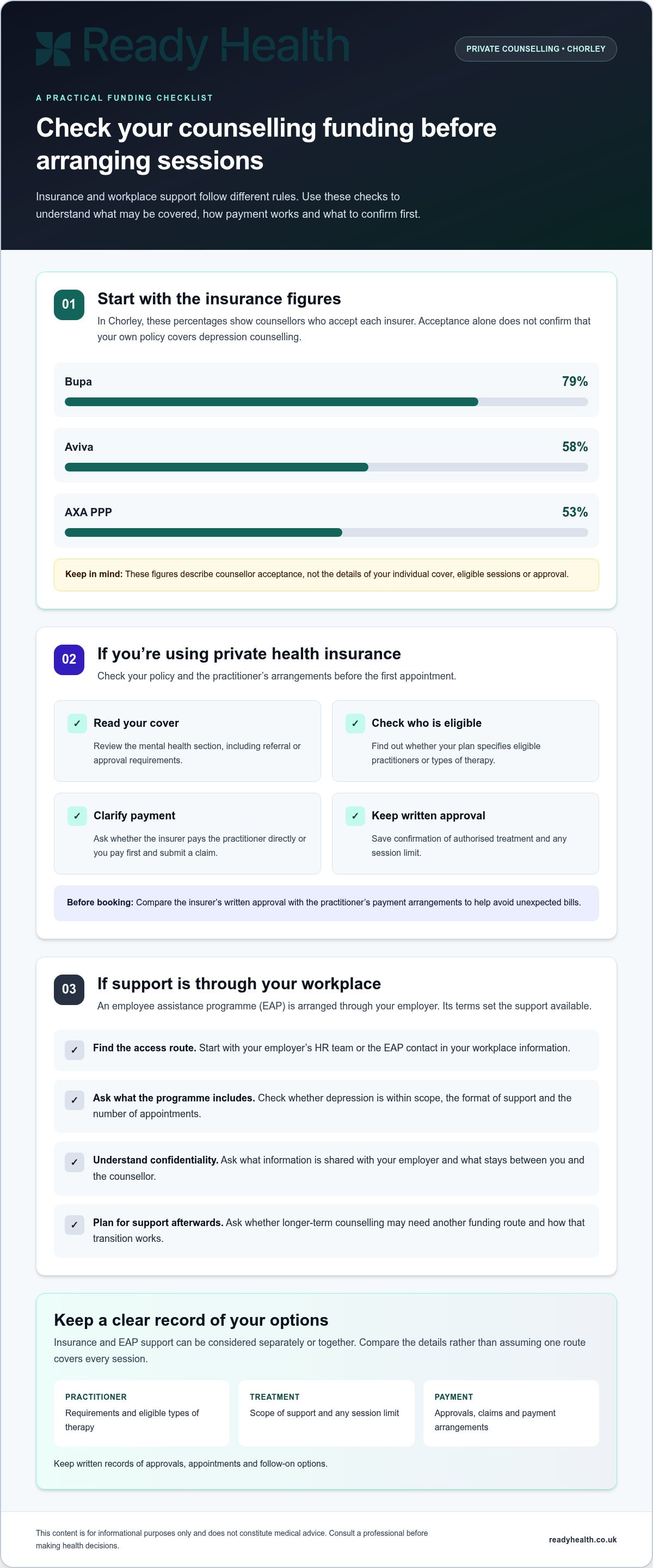
Health insurance policies set their own rules for mental health support. They may specify eligible practitioners, referral requirements, session limits and whether approval is needed before treatment. Check your policy wording to understand what counselling is covered and how payment works. One plan might pay the practitioner directly, while another may require you to pay first and submit a claim.
Local acceptance figures can help you understand the market, but they don’t describe your individual policy. In Chorley, 79% of counsellors accept Bupa insurance, 58% accept Aviva insurance and 53% accept AXA PPP insurance. These figures refer to counsellors’ acceptance of those insurers. They don’t tell you whether your specific policy covers depression counselling or how many sessions it allows.
Use this sequence to clarify your cover before arranging sessions:
- Read the mental health section of your policy, including any approval or referral requirements.
- Identify whether your plan names eligible counsellors, therapists or types of therapy.
- Ask your insurer how payment is handled and what information a claim requires.
- Keep written confirmation of the authorised treatment and any session limit.
If Bupa is named in your policy, for example, a counsellor’s acceptance of Bupa is only one part of the decision. Your cover may require a particular type of practitioner or prior authorisation. To avoid unexpected bills, compare the insurer’s written approval with the practitioner’s payment arrangements before the first appointment.
How an employee assistance programme differs
An EAP is arranged through your employer, so access depends on the programme available at your workplace. It may provide a way to discuss personal concerns, including low mood, with a support professional. The employer’s arrangement sets the service’s scope, format and number of appointments. This differs from insurance, which follows your policy’s benefits and claims process.
Start with your employer’s HR team or the EAP contact listed in your workplace information. Ask how to access counselling, whether depression is within the programme’s scope, and what support is available afterwards. An EAP may offer an initial period of help, while longer-term counselling could require another funding route. The programme’s terms explain how that transition works.
Confidentiality is another practical consideration. Ask the EAP administrator what information is shared with your employer and what remains between you and the counsellor. Understanding the privacy arrangements beforehand can help you feel more prepared to discuss personal matters. Keep the answer with the access instructions for a clear record of the process and its boundaries.
Insurance and EAP support can be considered separately or together. Compare practitioner requirements, treatment scope and payment arrangements for each route. Keeping written records of approvals, appointments and follow-on options can help you plan support without assuming one funding source covers every session.
When should someone with depression seek urgent help instead of waiting for counselling in Chorley?
Do not wait for a routine counselling appointment if you or someone else is in immediate danger. If you or someone else is in immediate danger, seek emergency help rather than waiting for counselling. If you’re experiencing a mental health crisis, call NHS 111 and select the mental health option, available 24 hours a day, 7 days a week.
Recognise when a crisis needs urgent attention
A counselling appointment can provide space to explore depression, but it isn’t an emergency response. If you’ve already harmed yourself, or someone you know has been harmed, use 999 rather than waiting for a scheduled session. If you’re in crisis but no one has been harmed, call NHS 111 and choose its mental health option. Tell the person answering that you’re experiencing a mental health crisis and need urgent support.
You don’t need to wait until you reach crisis point before seeking counselling. People in the UK can seek counselling without being in crisis, and counselling may help with depression and anxiety. The key distinction is whether you need immediate crisis support now, rather than a planned space to discuss your thoughts, feelings and behaviours. For example, someone looking for ongoing support can explore counselling, while someone in crisis should contact NHS 111.
What to do while seeking urgent help
Taking a first step can feel difficult when you’re overwhelmed. Use this simple sequence to find appropriate support:
- If someone has been harmed, call 999. This applies if you’ve harmed yourself or know another person has been harmed.
- If you’re in a mental health crisis, call NHS 111. Select the mental health option, which is available 24 hours a day, 7 days a week.
- Explain the immediate concern plainly. For example, say, “I’m experiencing a mental health crisis,” or explain that someone has been harmed.
- Follow the instructions you receive. Focus on the immediate support being arranged before returning to routine counselling plans.
If calling feels difficult, ask someone you trust to sit with you while you make the call, or to speak first if you cannot manage. You can also write down the key information before calling, such as what has happened and whether anyone has been harmed. Keep the NHS 111 number available so you don’t need to search for it during a crisis. If the situation involves harm, call 999.
How counselling fits after urgent support
Once an immediate crisis has been addressed, counselling may be part of ongoing support for depression. A counsellor can provide a confidential, non-judgemental space to explore personal concerns and consider possible ways forward. This planned support is different from urgent crisis help. You can seek counselling without being in crisis; it isn’t only for emergencies.
If you’re arranging counselling in Chorley, make the urgency clear when describing what you need. For example, explain whether you’re seeking a regular opportunity to discuss depression or whether you’re currently in crisis. If you’re in crisis, don’t wait for a private counselling appointment: call NHS 111 and select the mental health option. If you or someone else has been harmed, call 999. Keeping these routes distinct helps you choose an appropriate next step.
A counsellor can offer a confidential, non-judgmental space to discuss personal issues with a skilled professional. Within that space, a person can explore their thoughts, feelings and behaviours and find their own solutions. This kind of conversation can be part of ongoing support after immediate safety has been addressed: it gives room to consider personal concerns, rather than replacing urgent help when a crisis is happening. Counselling is a possible next step for discussion and reflection, while the urgent options above remain the response to immediate danger or harm.
Private counselling in the UK can offer a wider choice of therapists and may allow someone to be seen sooner than through other services. For someone considering ongoing support, that wider choice and the possibility of being seen sooner may be relevant when arranging a next step. These options concern planned counselling, not emergency care. If urgent support is needed, address that first; counselling can then provide space to explore personal issues, thoughts, feelings and behaviours, and work towards finding solutions.
Ready Health: Private GP Consultation (15 Minutes)
Ready Health’s Private GP Consultation (15 Minutes) gives you time to discuss low mood, explain what you’re experiencing and consider appropriate next steps. It may suit you if you want to speak with a GP about your concerns or need guidance on possible support for depression. A longer Private GP Consultation (30 Minutes) is also available if you’d prefer more time to talk.
A GP consultation is separate from counselling and isn’t an emergency service. If you’re in a mental health crisis, use the urgent support options described above rather than waiting for a routine appointment. For non-emergency concerns, you can book a GP consultation to discuss your situation.
Take your next step towards support
Choosing support is personal. Consider what would make it easier to begin, such as writing down your concerns or preparing questions for an appointment. If managing daily life at home alongside mental health concerns requires practical assistance, services like bloomfield-care.com offer person-centred domiciliary support to help maintain day-to-day wellbeing. You can take the next step at your own pace.
If you’d like to discuss counselling and possible next steps, contact Ready Health. Taking the first step can help you move towards support that feels right for you.
Frequently Asked Questions
Are therapy sessions confidential?
Counselling sessions are intended to provide a confidential space to discuss personal concerns. Before starting, ask the counsellor how session notes are handled, who can access them and when information might need to be shared. You can clarify whether anything discussed would be shared with an insurer or an employee assistance programme. Understanding these boundaries can help you decide what you feel comfortable sharing.
What should I prepare before my first counselling session?
You don’t need to prepare a full account of everything you’ve experienced. It may help to note what has been troubling you, what you hope to gain from counselling and any questions about the counsellor’s approach. If speaking about it feels difficult, bring a few written prompts. You can also say you’re unsure where to start; the counsellor can help guide the conversation.
How can I decide between online and in-person counselling?
Consider where you feel most comfortable speaking openly and what fits your routine. Online sessions let you talk from a familiar, private space, while meeting in person may suit you better if you prefer face-to-face conversation. For online appointments, consider whether you have a quiet place and a reliable connection. You can discuss your preference and any concerns before beginning.
What if I don’t feel comfortable with my therapist?
Feeling able to speak openly matters. If something about the sessions feels uncomfortable, tell the counsellor what isn’t working and what might help you feel more at ease. You could discuss the pace, communication style or goals. If it still doesn’t feel like the right fit, consider whether a different counsellor or approach would suit you better.
This content is for informational purposes only and does not constitute medical advice. Consult a professional before making health decisions.

Article by
Shamir Patel
Shamir Patel is a UK-based Clinical Pharmacist and Independent Prescriber with a specialist focus on ADHD and weight management.
He is the Registered CQC Manager at Ready Health Medical Clinic, where he leads the development and delivery of safe, patient-centred services across ADHD assessment and treatment, weight loss programmes, and general medical care.
With a career spanning nearly three decades since qualifying in 1995, Shamir brings extensive clinical and operational experience across both community pharmacy and private healthcare.
He also serves as Deputy Superintendent Pharmacist and Lead Prescriber at PillSorted. He oversees high-volume prescribing services. He focuses on GLP-1 weight loss treatments and clinical governance.
Shamir is a SCOPE-accredited obesity specialist and has a strong interest in improving access to evidence-based ADHD care. He is known for his structured, guideline-driven approach, aligning his clinical practice with NICE recommendations and regulatory standards set by the GPhC and CQC.
Alongside his clinical work, Shamir is actively involved in mentoring prescribing pharmacists, developing standard operating procedures, and contributing to service innovation within digital and community healthcare settings. His work reflects a commitment to safe prescribing, patient education, and improving outcomes through practical, accessible care.
Disclaimer
The information on this website is provided for general educational and informational purposes only and is not intended as medical advice, diagnosis, or treatment. Articles reflect general guidance and may not be suitable for your individual circumstances. You should always seek advice from a qualified healthcare professional before starting, stopping, or changing any treatment, medication, or healthcare plan. While we aim to keep our content accurate and up to date, Ready Health makes no guarantees about the completeness, accuracy, or suitability of the information provided. Reliance on any information on this site is entirely at your own risk. If you have concerns about your health, please book an appointment with a suitably qualified clinician. In an emergency, contact 999 or attend your nearest A&E department.


