

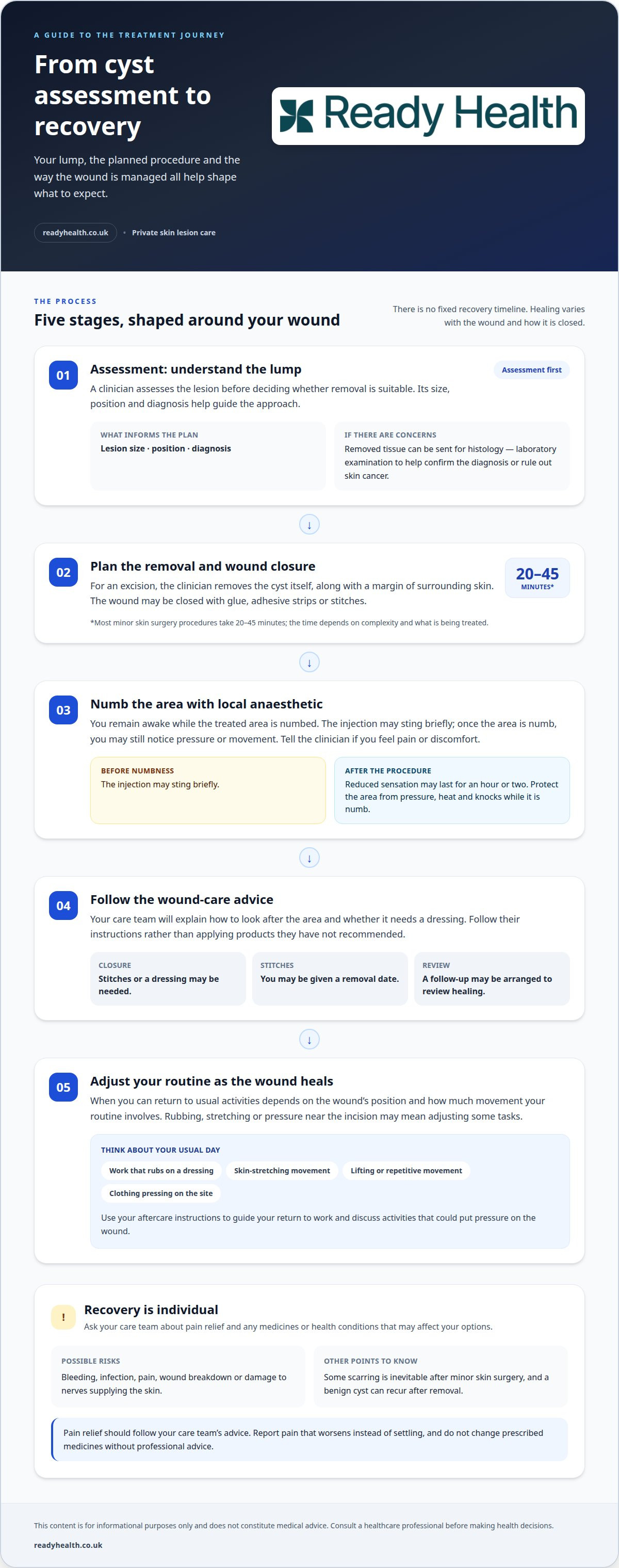
Cyst removal has no fixed recovery timeline. For private sebaceous cyst removal in Wigan, healing depends on the wound’s size and position, and whether it is closed with stitches or covered with a dressing. The procedure is usually performed under local anaesthetic, followed by wound-care and recovery advice. Temporary numbness may last for an hour or two.
It’s natural to want to know when you can return to your usual routine and how to care for the wound without disrupting daily life. Knowing what to expect can help you prepare.
This guide explains how a cyst is assessed, what removal involves, and what to expect from local anaesthetic, healing and aftercare. You’ll also learn how the cyst’s position and wound closure can affect recovery.
Key Takeaways
- Learn what wound-care advice may cover and how stitches or dressings can affect your recovery.
- Understand how local anaesthetic is used and what you may feel during and after the procedure.
- See why a clinician assesses a lump before deciding whether removal is suitable.
- Find out what removal may involve, including how tissue can be examined when there are concerns about the diagnosis.
Aftercare and recovery
Wound-care instructions depend on the procedure and how the wound is closed. Stitches or a dressing may be needed, with guidance on caring for the area as it heals.
Returning to Normal Activities
When you can return to normal activities depends on the wound’s position and how much movement your routine involves. For example, work that rubs against a dressing or stretches the skin near the incision may need more adjustment than desk-based tasks. Follow your care team’s instructions and discuss any activity that could put pressure on the wound before resuming it.
Pain Relief During Recovery
The treated area may feel sore after surgery, so follow your care team’s advice about pain relief. If you take medication or have a health condition that could affect your options, discuss suitable pain relief with a clinician. Don’t change prescribed medicines without professional advice, and report pain that worsens instead of settling.
Keep your dressing and wound-care instructions handy. Your care team will explain how to look after the area and whether it needs a dressing. Follow their guidance rather than applying products they haven’t recommended. If stitches are used, you may be given a removal date. A follow-up appointment may also be arranged to review healing.
Risks include bleeding, infection, pain, wound breakdown and damage to nerves supplying the skin. Some scarring is inevitable after minor skin surgery, although techniques aim to minimise it, particularly on the face or neck. A benign cyst can also recur after removal. Healing varies with the wound and how it is closed, so recovery time differs from person to person.
Plan your return to work around your wound, dressing and usual duties. Lifting, repetitive movement or clothing that presses on the site may call for different adjustments from seated work. Use your aftercare instructions to guide your routine, and discuss work-related concerns at follow-up. If there is still concern about the lesion’s diagnosis, a referral or further assessment may be appropriate.
Cyst removal procedure
Removal begins with an agreed technique and a plan for closing the wound. For private sebaceous cyst removal in Wigan, the lesion’s size, position and diagnosis help determine the approach.
Procedure Duration
Most minor skin surgery procedures take 20-45 minutes, depending on complexity. An excision removes the whole lesion and a margin of surrounding skin. The wound may then be closed with glue, adhesive strips or stitches. A skin tag may need a different technique, so the appointment length depends on what is being treated and how it is removed.
Removal Prices and Fees
Private procedure fees depend on the treatment required and the case’s complexity. A detailed fee is provided after a dermatology consultation and diagnosis, when the clinician can explain the planned technique and wound closure. For private sebaceous cyst removal in Wigan, this means the quote is based on an assessment of your lesion, rather than assuming every cyst needs the same approach.
Private and NHS Treatment Options
Private and NHS care follow different pathways for assessment and treatment. In Wigan, compare the proposed clinical plan for your concern rather than assuming the same route or eligibility applies to everyone. A private quote follows consultation and diagnosis. NHS arrangements depend on the pathway for your concern, so discuss your options with a clinician.
Histology and Follow-Up
Histology is the laboratory examination of removed tissue. If a lesion is a concern, the tissue can be sent for analysis to confirm the diagnosis or rule out skin cancer. An optional review with a clinical nurse is available two weeks after cyst removal. As the quote follows consultation and diagnosis, clarify how the procedure, any tissue analysis and optional review relate to the fee.
Local anaesthetic
Sebaceous cyst removal is usually performed under local anaesthetic, which numbs the treated area. You remain awake during the procedure.
Excision Under Local Anaesthetic
For excision, the clinician first numbs the skin around the cyst. Excision removes the cyst itself, rather than simply draining its contents. Local anaesthetic helps prevent pain in the treated area during surgery. You may still feel pressure or movement, so tell the clinician if you experience pain or discomfort.
Comfort During Local Anaesthesia
The anaesthetic injection may sting briefly before the area becomes numb. The clinician can pause to check your comfort before starting. Reduced sensation may last for an hour or two after benign skin lesion removal. Protect the area while it is numb, as you may not notice pressure, heat or accidental knocks.
Local anaesthetic differs from mild sedation. It numbs one area, while sedation affects alertness; local anaesthetic is the usual approach for minor skin surgery. Your clinical assessment helps determine whether excision is suitable and what to expect. Discuss any concerns beforehand, including previous reactions to anaesthetic or anxiety about staying awake.
For private removal in Wigan, look for a clinic that offers assessment and skin lesion removal. A clinic performing the procedure can explain the proposed technique, anaesthetic and aftercare before you decide. The procedure is usually carried out under local anaesthetic, with your comfort considered throughout.
Before choosing a clinician, discuss their relevant skin surgery training and experience, and ask them to explain the procedure in plain language. A clear explanation should cover the assessment, why excision is being considered and how the wound will be managed. Raise specific concerns, such as a cyst that has changed, during assessment so they can inform the plan.
Assessment of cysts and other skin lesions
An initial assessment helps distinguish a cyst from other skin lesions and guide the next step. If you’re considering private sebaceous cyst removal in Wigan, a doctor can assess the lump before planning a procedure.
Sebaceous and epidermoid cysts are types of skin lump; an epidermoid cyst forms just beneath the skin. A pilar cyst is another type, often found on the scalp. Skin tags are small pieces of skin, while lipomas are soft lumps made of fatty tissue. A mole is a pigmented skin mark. Appearance alone may not confirm what a lump is, so don’t squeeze it before assessment.
Most skin lesions can be left alone if they cause no concern. People may consider removal if a lump is uncomfortable, repeatedly irritated or affecting daily life. If you’re exploring private sebaceous cyst removal in Wigan, assessment can establish whether surgery is appropriate. If the lesion’s appearance raises concern about cancer, removed tissue can be sent for laboratory analysis.
Scarring is an important consideration before removal. Minor skin surgery leaves some scar tissue, and the final appearance can depend on the lesion’s size and position. Extra care may be taken in areas such as the face or neck. Discuss likely scarring and healing during the initial consultation, especially if the lesion is visible or catches on clothing.
For a single cyst, the proposed procedure and its complexity affect the fee. If you have additional cysts, each needs assessment because size, position and diagnosis can differ. The number of lesions and techniques required can affect a multi-cyst quote. A detailed fee follows consultation and diagnosis, rather than a standard price applying to everyone.
Assessment can identify when removal may not be suitable or further investigation is needed. If a cyst changes, becomes painful or appears inflamed, discuss it with a doctor before arranging a procedure. A clear clinical plan should explain which lesions are being considered, why removal is proposed and whether tissue needs analysis.
Ready Health: Private GP Consultation (15 Minutes)
Ready Health’s Private GP Consultation (15 Minutes) gives you time to discuss a lump, its symptoms and your concerns with a GP. Bring up changes in size, tenderness, redness or discharge, and explain how long you’ve noticed the area. These details help the GP understand your concern and discuss an appropriate next step.
A consultation can help if you’re unsure whether a lump needs assessment or want to understand what happens next. Your GP can consider the information you share and explain whether further assessment or referral may be appropriate. The consultation does not guarantee that a particular procedure will be recommended.
If you’d like to discuss a skin lump with a GP, contact Ready Health to arrange a consultation.
Plan a clear next step
Choosing private sebaceous cyst removal in Wigan starts with deciding what you want to discuss. You may want to know whether the lump needs attention, what treatment could involve or how a visible scar might affect you. Note your main concern and any changes you’ve noticed so you can describe them clearly.
A useful appointment should leave you better informed about the options relevant to your situation. Ask how the proposed plan fits your priorities and what further steps may be considered. Understanding the discussion can help you make a considered decision about your care.
To talk through your cyst and arrange a GP consultation, contact Ready Health. A conversation can help you identify a practical next step at your own pace.
This content is for informational purposes only and does not constitute medical advice. Consult a healthcare professional before making health decisions.
Frequently Asked Questions
How long is recovery?
Recovery varies with the wound, its position and how it was closed, so there is no single timeline. Your care team can explain what to expect based on the procedure and how to protect the area. Before leaving, make sure you know who to contact if the wound changes or you’re concerned about healing.
Are there any alternatives to surgery?
Yes. If a cyst or other skin lesion isn’t causing problems, it may be left alone. However, leaving it in place doesn’t remove it, and other approaches shouldn’t be assumed to have the same effect as surgical removal. A clinician can assess the lump and discuss whether monitoring, removal or another assessment is appropriate.
Can I return to work after the procedure?
Your return to work depends on the wound’s location and the demands of your role. Consider whether your uniform, protective equipment or daily tasks might rub, press on or stretch the treated area. Discuss these practical details with your clinician before the procedure so you can plan temporary adjustments and follow your wound-care instructions at work.
How do I know if my lesion is suitable for removal by the GP?
A GP needs to assess the lesion before deciding whether removal is suitable. They’ll consider its appearance, location, behaviour and whether the diagnosis is clear. A lump that changes or raises concern may need further assessment rather than routine removal. The consultation helps clarify the safest next step for your lesion.
How much does it cost?
The fee depends on the procedure required and the lesion’s complexity. A detailed quote is provided after consultation and diagnosis, when the clinician can identify an appropriate approach. If you’re considering removing more than one lesion, mention this during assessment, as each may need a different plan. Ask what the quote includes before agreeing to proceed.
Does private cyst removal in Wigan require a GP referral or consultation?
A clinical consultation is a practical first step because the lump needs assessment before a removal plan can be made. You can discuss it with a private GP, who can consider whether removal is suitable or further specialist assessment may be appropriate. If you have information from another clinician, bring it along to help explain your concern and history.
Contact Ready Health to discuss your cyst and arrange a consultation.
This content is for informational purposes only and does not constitute medical advice. Consult a healthcare professional before making health decisions.
Article by
Shamir Patel
Shamir Patel is a UK-based Clinical Pharmacist and Independent Prescriber with a specialist focus on ADHD and weight management.
He is the Registered CQC Manager at Ready Health Medical Clinic, where he leads the development and delivery of safe, patient-centred services across ADHD assessment and treatment, weight loss programmes, and general medical care.
With a career spanning nearly three decades since qualifying in 1995, Shamir brings extensive clinical and operational experience across both community pharmacy and private healthcare.
He also serves as Deputy Superintendent Pharmacist and Lead Prescriber at PillSorted. He oversees high-volume prescribing services. He focuses on GLP-1 weight loss treatments and clinical governance.
Shamir is a SCOPE-accredited obesity specialist and has a strong interest in improving access to evidence-based ADHD care. He is known for his structured, guideline-driven approach, aligning his clinical practice with NICE recommendations and regulatory standards set by the GPhC and CQC.
Alongside his clinical work, Shamir is actively involved in mentoring prescribing pharmacists, developing standard operating procedures, and contributing to service innovation within digital and community healthcare settings. His work reflects a commitment to safe prescribing, patient education, and improving outcomes through practical, accessible care.
Disclaimer
The information on this website is provided for general educational and informational purposes only and is not intended as medical advice, diagnosis, or treatment. Articles reflect general guidance and may not be suitable for your individual circumstances. You should always seek advice from a qualified healthcare professional before starting, stopping, or changing any treatment, medication, or healthcare plan. While we aim to keep our content accurate and up to date, Ready Health makes no guarantees about the completeness, accuracy, or suitability of the information provided. Reliance on any information on this site is entirely at your own risk. If you have concerns about your health, please book an appointment with a suitably qualified clinician. In an emergency, contact 999 or attend your nearest A&E department.


