

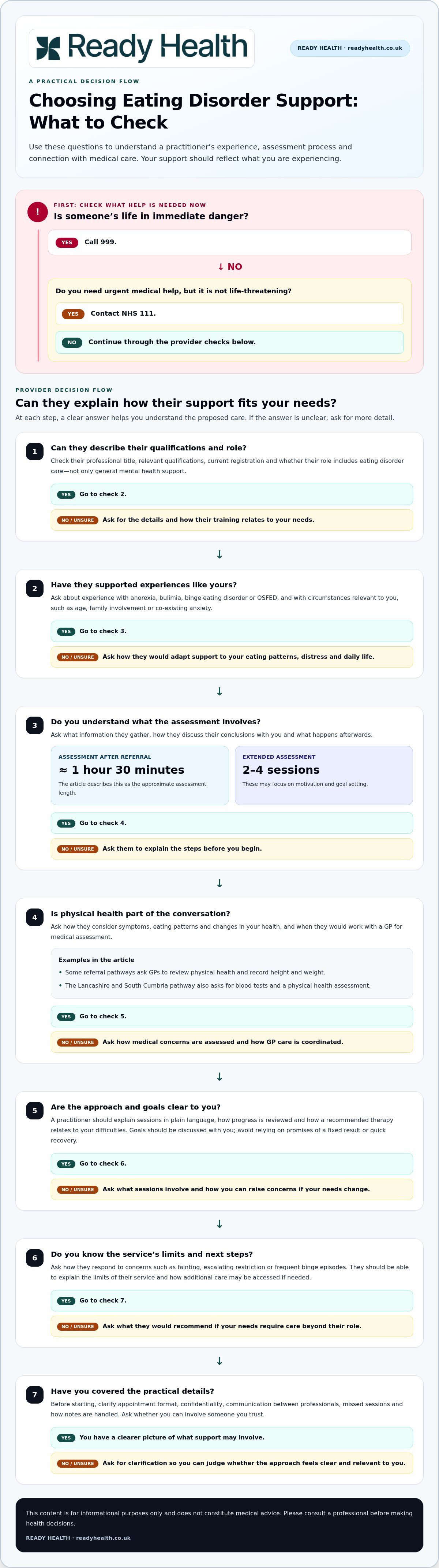
Eating disorder support should respond to what you’re experiencing, not just a diagnosis. Private eating disorder support in Leigh may include an assessment and counselling for anorexia, bulimia, binge eating disorder or OSFED, a term for other specified feeding or eating disorders. If someone’s life is in immediate danger, call 999; for urgent medical help when it isn’t life-threatening, contact NHS 111, according to the NHS.
It can feel difficult to ask for help, especially if you’re unsure whether your eating or thoughts about food are “serious enough”. You don’t need to wait for a crisis to seek support. This guide explains what private care may involve, what to consider when choosing a practitioner and how to find a next step that suits you. It also explains where to turn for urgent or crisis help in Leigh.
Key Takeaways
- Look for a practitioner with relevant qualifications and specific experience supporting eating disorders, not just general mental health experience.
- Anorexia, bulimia, binge eating disorder and OSFED can affect people in different ways, so support should reflect your individual needs.
- Know where to turn if you need urgent help, and how to respond if there is an immediate risk to life.
- A private GP consultation can give you space to discuss your concerns and consider appropriate next steps.
What qualifications and eating disorder experience should I check when choosing a private provider?
Start by finding out who will assess and support you. Ask for the practitioner’s professional title, relevant qualifications and current registration details. Confirm that their role includes eating disorder care rather than assuming general mental health experience is enough. For private eating disorder support in Leigh, look for a clear explanation of how their training relates to your needs.
Eating disorders can affect mental and physical health. Look for experience with the concerns you want help with, such as anorexia, bulimia, binge eating disorder or OSFED. Ask how the practitioner addresses eating patterns, emotional distress and everyday functioning. For example, support for binge eating should reflect your experience, rather than treating every eating disorder in the same way.
Ask whether the practitioner has supported people with experiences like yours. Relevant experience might include working with adults or young people, involving family members, or supporting people with co-existing anxiety. Ask how appointments can be adapted if discussing food, weight or body image feels difficult. Their answer should explain how you can agree goals and raise concerns if your needs change.
Understand what an assessment involves before you begin. An eating disorder assessment after referral lasts approximately 1 hour and 30 minutes. An extended assessment may consist of 2-4 sessions focused on motivation and goal setting. Ask what information the practitioner gathers, how they discuss their conclusions with you and what happens after assessment.
Physical health should be part of the discussion, not an afterthought. Ask how the practitioner considers symptoms, eating patterns and changes in your health, and how they work with a GP when a medical assessment is needed. Some referral pathways ask GPs to review physical health and record height and weight. The Lancashire and South Cumbria pathway also asks for blood tests and a physical health assessment. These examples show why it matters to understand how psychological support connects with medical care.
Ask the practitioner to explain their approach in plain language. Find out what sessions involve, how progress is reviewed and how you can raise concerns. If they recommend a particular therapy, they should explain its purpose and how it relates to your difficulties. A useful answer connects treatment with goals you have discussed, rather than promising a fixed result or quick recovery.
Use these questions to guide an initial conversation:
- What qualifications and professional registration support your eating disorder work?
- Which eating disorders have you supported, and what did that support involve?
- How do you consider physical health concerns and coordinate with a GP?
- How will we agree goals and review whether the approach is useful?
- What would you recommend if my needs require care beyond your role?
Notice whether the practitioner gives specific examples. They should be able to explain how they respond when someone reports fainting, escalating restriction or frequent binge episodes. They should also describe the limits of their service and how additional care can be accessed. Clear boundaries help you understand what support is appropriate and when another level of care may be needed.
Before starting, clarify the appointment format, confidentiality, communication between professionals and what happens if you miss a session. Ask how notes are handled and whether you can involve someone you trust. Knowing these details can help you prepare for your first appointment. When comparing private eating disorder support in Leigh, use them to judge whether the proposed approach feels clear and relevant to your situation.
Mental health
An eating disorder can affect mood, concentration, relationships and daily routines. For example, anxiety about meals may lead you to avoid eating with friends or family. You might also feel guilt, shame or distress after eating. These experiences deserve attention alongside changes in eating behaviour.
Eating disorder patterns vary. Anorexia may involve restriction and intense fears about food or weight. Bulimia can involve cycles of binge eating and compensatory behaviours, such as making yourself sick. Binge eating disorder involves episodes of eating with a sense of lost control. OSFED describes eating difficulties that cause distress but do not fit another specific diagnosis.
Describe what happens rather than trying to decide whether your symptoms are severe enough. Note examples such as skipping meals, eating in secret, feeling unable to stop, or using exercise to compensate. You can also record how these patterns affect sleep, study, work and relationships. These details can help you explain what support you need.
Eating disorders are not limited to one gender. One service estimates that around 10% to 20% of people experiencing eating disorders are male. Men may face additional barriers if they feel eating disorders are seen as a women’s issue. If you’re concerned about yourself or someone else, describe the behaviours and distress clearly, without relying on stereotypes.
Age and timing can shape which pathway is relevant. The FREED pathway is for people aged 16 to 25 with a first-episode eating disorder lasting less than three years. Its age range and early-intervention focus may be relevant when exploring support options. If you’re outside those criteria, discuss other suitable routes with a healthcare professional.
For adults, treatment may include psychological therapy focused on eating disorder thoughts and behaviours. Cognitive Behavioural Therapy for Eating Disorders, or CBT-E, is a structured therapy that addresses these patterns. Support may also take anxiety, low mood or relationship pressures into account. Ask how sessions will connect practical eating goals with your emotional wellbeing.
Involving someone you trust may make it easier to attend appointments or follow agreed plans. You could ask a partner, relative or friend to help you prepare questions or notice changes in your mood. If you’re supporting someone else, listen without blame and avoid comments about their body or food choices. Offer practical help, such as accompanying them to speak with a professional.
Take urgent changes seriously. If someone is fainting, becoming physically unwell, or struggling to stay safe, seek medical help promptly. The NHS advises calling 999 for a life-threatening emergency. For medical help or advice when the situation isn’t life-threatening, contact NHS 111. If you’re unsure how urgent the situation is, explain the symptoms and eating-related concerns clearly.
If thoughts of self-harm or suicide arise, tell a trusted person and seek urgent professional help. For immediate danger to life, call 999 according to the NHS. For urgent medical advice that isn’t life-threatening, call 111. Share concrete details, such as what has changed, when it began, and whether the person can remain safe.
To prepare for a conversation, write down your main concern, an example of a difficult moment and the help you want. You could say, “I’m avoiding meals with other people, and it’s affecting my daily life.” If a private appointment feels like a useful first step, you can book a consultation to discuss your concerns.
Access to care can take time, and a long wait does not mean concerns are unimportant. More than 6,000 children and young people in England were waiting for eating disorder treatment at the end of December. More than seven in 10 people still waiting for urgent eating disorder treatment at the end of 2023 had already waited at least three months. In Hampshire, the number of young people receiving care for severe eating disorders rose from 144 in 2016 to 247 in 2024. Some young people in Leigh House's care had been diagnosed with anorexia two or three years earlier.
While waiting, tell your doctor if eating difficulties or emotional distress worsen, and ask what support is available. A doctor may send someone with anorexia to hospital if they are under 18 and the doctor believes they have insufficient support at home. People with immediate risk to life outside working hours can attend an A&E department. If there is immediate danger, seek urgent help; a trusted person may help communicate what has changed.
Ready Health: Private GP Consultation (15 Minutes)
Ready Health offers a Private GP Consultation (15 Minutes) if you want to discuss eating-related concerns with a GP. You can explain what you’ve noticed, how it affects daily life and what support you’re seeking. Bringing brief notes about symptoms, changes and questions can help you use the appointment well.
A GP consultation can be a starting point for discussing your health and appropriate next steps. If you need more time to cover several concerns, a Private GP Consultation (30 Minutes) is also available. Private appointments are not a crisis service. For an immediate risk to life, call 999; for urgent medical advice that isn’t life-threatening, contact NHS 111, according to the NHS.
If you’d like to discuss your concerns, visit readyhealth.co.uk to explore booking a consultation.
Choose one manageable next step
Taking the first step towards support doesn’t mean you need to have every answer ready. Write down what feels hardest today, or tell someone you trust that you’re considering getting help. A small action can make it easier to begin a conversation on your terms.
Give yourself permission to speak plainly, even if you’re unsure how to describe what’s happening. This content is for informational purposes only and does not constitute medical advice; consult a professional before making health decisions. To discuss support, contact Ready Health.

Article by
Shamir Patel
Shamir Patel is a UK-based Clinical Pharmacist and Independent Prescriber with a specialist focus on ADHD and weight management.
He is the Registered CQC Manager at Ready Health Medical Clinic, where he leads the development and delivery of safe, patient-centred services across ADHD assessment and treatment, weight loss programmes, and general medical care.
With a career spanning nearly three decades since qualifying in 1995, Shamir brings extensive clinical and operational experience across both community pharmacy and private healthcare.
He also serves as Deputy Superintendent Pharmacist and Lead Prescriber at PillSorted. He oversees high-volume prescribing services. He focuses on GLP-1 weight loss treatments and clinical governance.
Shamir is a SCOPE-accredited obesity specialist and has a strong interest in improving access to evidence-based ADHD care. He is known for his structured, guideline-driven approach, aligning his clinical practice with NICE recommendations and regulatory standards set by the GPhC and CQC.
Alongside his clinical work, Shamir is actively involved in mentoring prescribing pharmacists, developing standard operating procedures, and contributing to service innovation within digital and community healthcare settings. His work reflects a commitment to safe prescribing, patient education, and improving outcomes through practical, accessible care.
Disclaimer
The information on this website is provided for general educational and informational purposes only and is not intended as medical advice, diagnosis, or treatment. Articles reflect general guidance and may not be suitable for your individual circumstances. You should always seek advice from a qualified healthcare professional before starting, stopping, or changing any treatment, medication, or healthcare plan. While we aim to keep our content accurate and up to date, Ready Health makes no guarantees about the completeness, accuracy, or suitability of the information provided. Reliance on any information on this site is entirely at your own risk. If you have concerns about your health, please book an appointment with a suitably qualified clinician. In an emergency, contact 999 or attend your nearest A&E department.


